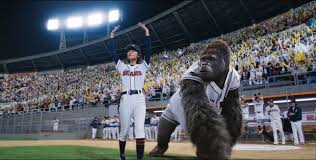
Fifteen year old Wei-Wei (Xu Xiao) is the young ringmaster of a failing circus troupe in China where the star attraction is Ling-Ling, a baseball-playing gorilla reared by Wei-Wei's adopted grandfather (Byun-Hee Bong). Unfortunately grandpa is less in love with baseball than the chance to bet excessively on the sport. So when the old man dies in the Great Sichuan Earthquake poor Wei-Wei inherits his massive gambling debts which put the circus in jeopardy from violent loan shark Lin Xiaogang (Kim Hie-Won). Which is when shady, self-serving sports agent Sung Chung-Su (Sung Dong-Il) arrives with a lucrative offer: a chance for Ling-Ling to go pro in the Korean baseball league. Rechristened 'Mr. Go', Ling-Ling and his peppy young trainer sign with an ailing South Korean team called the Doosan Bears. After a shaky start, his phenomenal batting skills turn their fortunes around. But Sung's greed and Wei-Wei's bull-headed determination to save the circus at all costs take their toll on the long-suffering gorilla.
Given the premise one might expect a goofy comedy along the lines of the infamous Matt Le Blanc flop Ed (1996). Yet despite some solid laughs director Kim Yong-Hwa forgoes amiable ape humour and instead pitches Mr. Go as earnest drama. In fact this mega-budget Chinese-South Korean co-production goes about detailing and satirizing the politics, dodgy business practices and financial wrangling behind the Asian baseball industry with all the serious intent of Moneyball (2011). Which is not what audiences were expecting in South Korea where the film flopped ending Kim Yong-Hwa's streak of crowd-pleasing comedy hits. However, Mr. Go became an enormous smash hit across China which was a far bigger, more lucrative market. So Kim had the last laugh after all.
Although adapted from Huh Young-Man's 1984 manga (or manhua in South Korea) 'The 7th Team', the inspiration for Mr. Go according to Kim Yong-Hwa was a YouTube video of Christian the Lion, famously purchased from the Harrods department store in London before eventually reintroduced to the wild. Kim was fascinated with the idea of a wild animal interacting with humans on a social level. However, he tempers the sense of wonder inherent in the fantastical premise with what seems like acknowledgement of show-business' dubious history of exploiting animals. The Asian entertainment industry in particular does not share the same sentimental attachment to animals many have in the West. Hence Kim draws the relationship between gentle giant Ling-Ling and feisty Wei-Wei in a manner far more strained and complex than mainstream films typically present between an animal and child. The scowling girl motivates Ling-Ling with severe scolding or else a crack of the whip albeit just the noise. She doesn't hit him. Although fond of the ape for a large part of the plot Wei-Wei clearly regards Ling-Ling as a means to an end, which is to save her family of orphaned circus children. However her character arc climaxes with the realization she stands as guilty as anyone of exploiting poor Ling-Ling. On the other hand Shing's inevitable transformation from shallow corporate shill to caring nice guy is a lot harder to buy given his characterization wavers inconsistently throughout from comical antihero to loathsome monster.
Japanese superstar Jo Odagiri, hugely popular in South Korea, pops up in a supporting role as a sinister Japanese baseball manager sporting a ridiculous Beatle-esque mop-top haircut. As mentioned before Mr. Go pulls off a fair few laugh out loud moments. It is hard not to crack a smile watching Ling-Ling strut around the baseball field to the sound of (what else?) Dire Straits' 'Walk of Life.' That karaoke standard 'Danny Boy' also figures prominently on an eccentric soundtrack alongside a gag reference to Taiwanese songstress Teresa Tang (onetime girlfriend of Jackie Chan and an iconic figure in Asian pop culture) likely to go over the heads of most English viewers. Yet a good deal of the humour proves surprisingly sadistic including a running gag about mob boss Lin and his sadomasochistic attachment to Lei Ting, another gorilla from Wei Wei's circus who becomes a lightning fast pitcher and Ling-Ling's rival despite being dangerously unstable.
Gifted and personable child star Xu Jiao gives an engaging performance. Making use of previous interactions with computer-generated creatures in CJ7 (2008), the Stephen Chow Sing-Chi comedy that made her a star, and Starry, Starry Night (2011), her finest film, she interacts flawlessly with the impressively lifelike CGI ape. On a technical level Mr. Go's effects team match the animatronic achievement of Rick Baker's work on Greystoke: The Legend of Tarzan, Lord of the Apes (1984). The spectacular effects combine with swirling widescreen camera acrobatics and epic scenery to create some truly exciting set-pieces. Notably an amusing King Kong parody where Ling-Ling runs amuck at the baseball stadium and the by turns tense, hilarious and moving finale that tips its hat to The Natural (1984) only played for farce and climaxing with a big gorilla-on-gorilla fight scene. Yet the film struggles to remain consistently engaging on an emotional level. At two hours plus it is overlong and, like many South Korean blockbusters, weirdly intense in moments that could use a lighter touch.