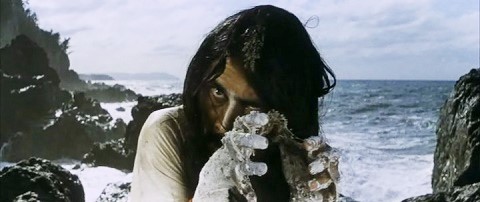
Hirosuke Hitomi (Teruo Yoshida) has found himself in a caged room with a bunch of half-naked, insanely raving women, and one of them is trying to stab him with a dagger. He struggles with her until she overpowers him and plunges the blade into his chest, but as the attendant walks over it is revealed the knife was a trick one with a retractable blade, and Hitomi is fine. He is escorted out, still trying to piece together how he ended up here, as all he can recall are parts of memories that don't make much sense: something about an island, a madman, victimised women and men, but where does he fit into it all? The problem is about to be solved in a most violent manner when he is attacked yet again…
Horrors of Malformed Men was banned for decades in Japan, mainly because of its depiction of the disabled which was considered incredibly offensive, but that simply made it all the more intriguing for both fans of its director Teruo Ishii, and more dedicated fans of extreme horror in general, so when it was finally re-released they got to see what the fuss was all about. Although not necessarily be able to follow what the hell was going on, for the plot was unbelievably convoluted, so much so that a last act, Agatha Christie-style gathering of the characters for one of them playing detective to explain to them all their part in events, only not set in a wood-panelled drawing room but a dank cave by the ocean, was so baffling that you could award yourself a prize for unravelling it.
Not to mention a capper to all that mayhem that made a kind of emotional sense, yet logically was absolutely preposterous and had to be seen to be believed. Many Westerners described this as a variation on H.G. Wells' The Island of Doctor Moreau, where the villain of the title used surgery to turn animals into people, but Ishii claimed he had never heard of the book before he made his film, and in fact as the opening titles proclaimed, this was based on Japan’s most celebrated classic horror author's works, he being Edowago Rampo, whose heyday had been some decades before this was created. For that reason, there were those of the opinion that the mad scientist's endeavours here were more influenced by the horrors of atomic bomb warfare.
Which Japan had experience of, and had informed post-war culture, especially the fantastical genres, ever since. No wonder the powers that be were uncomfortable about a storyline where we were supposed to take entertainment from what basically amounted to its antagonist creating radiation equivalent victims for his own amusement – quite why he is doing what he does outside of absolute insanity remains rather obscure. Once Hitomi is back on the island of his nightmares, he sees things more clearly – you'll be glad somebody does – taking the role of his dead lookalike, a member of the family who lives there and all seem to be wrapped up in themselves to the point of mental instability.
That brought us to a common theme in Japanese shockers, the terror of perversity. Long before long-haired, white-robed and deeply troubled young ladies became a trend in the nation's chillers, the fear that you may be dealing with a pervert, or indeed had become one yourself, played a major part in pop culture, and Horrors of Malformed Men was one work among quite a few that contributed to setting the scene for the far more explicit nineteen-seventies exploitation cinema out of Japan. Here being sexually twisted leads the baddies to do anything from take carnal pleasure in outright sadism to hiding in a special chair that assumed the shape of them sitting down, all so that they could be sat on themselves by an unwitting lady – ecstasy ensued. But then there was the scene of the girl eating the crabs who are eating the decomposing body of her deceased lover, and as the film drew on there was a devastated romanticism that made itself plain. If you concentrated very hard, it was even possible to follow what was happening, though the delirium was a big element in its weirdo spell. Music by Hajime Kaburagi.