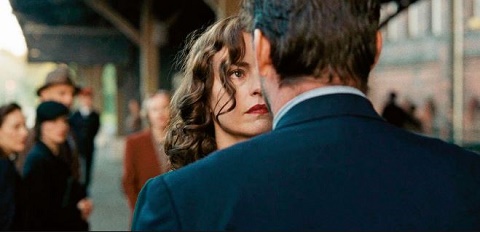
World War II has recently ended, and Nelly Lenz (Nina Hoss) should be immensely relieved that she survived it, being a Jew who was sent to Auschwitz but was not put to death before the Allies liberated the death camp. However, there are reasons she finds no solace in her freedom, she wishes things could go back to as they were before the tragedy of the conflict when she was married to Johnny (Ronald Zehrfeld) and happy in a comfortable life in Berlin, making a good living as a lounge singer with him as her pianist. Now, her face has been ruined by Nazi violence, and she returns to the capital with her face bandaged, accompanied by her only friend Lene (Nina Kunzendorf), seeking surgery to restore her looks…
Director Christian Petzold reunited once more with his favourite leading lady Nina Hoss for this post-war drama, and once again she made the movie for him. Her portrayal of a damaged soul, both physically and mentally, was pitched just right to have us believe absolutely Nelly was suffering deep trauma, just as all Jews were, even those who had not been caught up in the hell in Europe, and she became emblematic of the entire race who had endured through terrible circumstances and were left feeling, well, what now? The fact they had got through what was a test of mettle, to put it mildly, should have made them triumphant, yet too many people had died and the fact so many millions wanted them exterminated simply left them shattered.
That’s the impression you take from watching Hoss, and her Nelly was so doleful that she managed to carry what was a curiously withdrawn and tentative drama, as if the characters were frightened that if they made too much noise, too much fuss even, they could set off the whole chain of dreadful events once again. That sense of repeating history, or rather the terror that it could if we were not careful, was inherent in Nelly’s story as now she has had the surgery and looks different, not as she wanted to, she determines to do her best to make sure she can return to the life as she knew it, in spite of all appearances that this is an impossibility. It’s more than a loss of innocence, it’s innocence getting kicked to the ground and stomped on to the point of near-death.
On the other hand, she could get revenge on Johnny who sold her out to the Gestapo, and therefore was responsible for her ordeal in the camps; if he had kept his mouth shut then maybe things would have been different though judging by the milieu of terror there was no guarantee Nelly wouldn’t have been exposed anyway. She does track him down in Berlin, where he is working as a waiter rather than a musician, and though he does not recognise her, he is intrigued enough to bring her into his scheme to inherit her money, which he thinks can pull him out of his doldrums. She reacts numbly to this further betrayal, but goes along with it as if barely aware of the awful ironies she is now a willing participant in – although she is now carrying a revolver, so will she use it on her ex-husband?
The Second World War may have been epic in scale, and the war movies it spawned could similarly tackle both spectacle and wrenching emotions if handled correctly, even one or the other was enough in many cases, yet Petzold preferred to stay low key and understated for almost the entire length of Phoenix. For this reason, a strange monotony of tone crept in early and refused to shift for the duration, which could well be offputting to those wishing for a more melodramatic approach: it was using that old chestnut of plastic surgery completely changing a face unrecognisably into another, and could easily have lapsed into camp. Or embraced it, for that matter. In spite of this hoary old cliché, and a none-too-believable one considering how careful the rest of the story was to ring true, something about it kept you watching, it could just have been to see if Nelly, who spends much of the film in a basement room being turned into herself Vertigo-style by Johnny, really does shoot him. However, the actual final scene, after all this restraint, was unexpectedly powerful, delivering an arresting finale through the use of song that was far more effective than any basic gunshot; it’s appropriate it should conclude by revealing its deception. Music by Stefan Will.