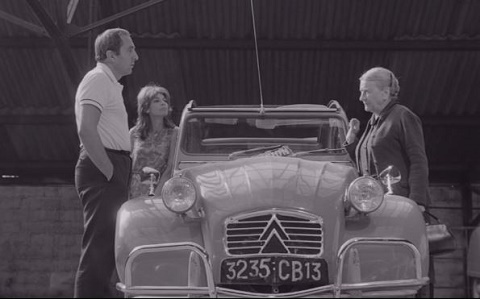
The family of Mr Bertini are used to false alarms, he has been ailing for some time and when they hear from his wife Madame Berthe (Sylvie) that she thinks he’s not long for this world, they are somewhat dismissive and fail to rush to his bedside in spite of her urging. Of course, they are indeed too late to see him pass, and it turns out the only person there when he goes is Berthe, but she doesn’t resent this – or does she? The family gathers for the funeral and pay their respects, but for the supposed matriarch there is nothing but mildly compassionate tolerance, they are keen enough to make sure she’s settled, but are frankly more interested in what money she can give them from what her husband has left her…
The Shameless Old Lady, or La vieille dame indigne as it was called in its native France, was an adaptation of a Bertolt Brecht story that showcased the talents of the by then elderly character actress Sylvie, who was by that point in her eighties. She had enjoyed a prestigious career mostly on the stage, but had made appearances in film since the silent days, and this was widely regarded as a swan song for a much respected talent. Maybe she wasn’t called on to do much more than wander from one scene to the next as the viewer imposed their own interpretation on Madame Berthe’s behaviour, but it was undeniable that she became the most life-affirming character in the entire piece.
This was entirely intentional as she effectively rejected her actual family and set up an alternative who would appreciate her far better and enable her to finally branch out on her own, not simply performing a role as a duty-bound part of the wife, mother, then grandmother, with no real personality of her own. Her offspring cannot understand why a woman of her advanced years would want to basically start spending their inheritance for her own ends, and time and again we see son Albert (Etienne Bierry) especially driven to distraction by what he sees as irresponsibility when his own finances – or lack of them – are running his life in such a joyless fashion. His son Pierre (Victor Lanoux) has something of the right idea by following his dream of being a musician.
However, even Pierre isn’t happy, because he still has to hold down a day job, and this was a recurring motif, that the daily grind was making nobody satisfied in contrast to Berthe who is making her way to something approximating happiness in this world rather than awaiting her reward in the next. So if she wants to enjoy an ice cream sundae or take regular trips to the cinema, behaviour which outrages the permanently outraged Albert, you have to tell her, knock yourself out, the idea that we’re put on this Earth to be put through various trials and tribulations may have validity to many, but the more positive aspect to living, to actually appreciate the good things that might come your way, should not be neglected either.
If this sounds uncharacteristically optimistic for Brecht, then bear in mind much of the plot was given over to depicting how miserable almost everyone except Madame Berthe was, so there was a social commentary here inasmuch as you could recognise what was a plainly delivered warning about how life could wear you down if you allowed it to, even not realising it was happening. That said, there was a touch or two of the soap opera about what from some angles could be a family saga, only played out over the course of eighteen months (we are told the months in captions as they go by), and while you could appreciate what director René Allio was getting at, that seize the day message he was bringing across, there remained a tendency towards the twinkly and cosy in his title character that the harsh realities of Albert et al didn’t quite eclipse. Still, it was nice enough, and had its heart in the right place, not to mention providing a send-off not only for Madame Berthe but for Sylvie also. Music by Jean Ferrat.