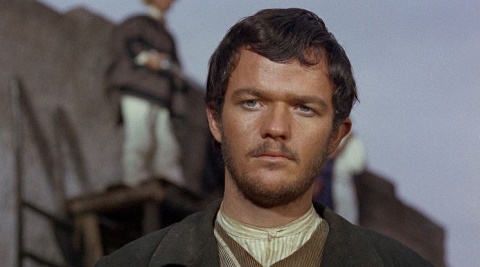
A few years ago, a border dispute in Mexico reached an impasse with both sides at loggerheads, the locals unwilling to back down against the Americans who were impinging on their territory, but against the odds a deal was arranged and the rivals met at an old church in the countryside to shake hands and set aside their differences. Alas, the Mexicans had been fooled: no sooner had the Americans congratulated them than they took cover and a heavy duty machine gun opened fire, massacring every non-American present. Well, not quite all, as one little boy managed to escape with a head wound, missed by the evil Dean Light (Ferruccio Viotti), right hand man to the orchestrator Ferguson (Mark Damon)…
That little boy’s injury had a curious effect on him as we discover as we watch him grow up in about a minute of montage with the priest who takes him under his wing. If ever there was a Spaghetti Western where the ability to shoot straight and hit every target was akin to a superpower it was this one, all the better to visit righteous vengeance on the bad guys, and that’s what the kid grows up with the talent to do. That adult version was played by Lou Castel and named after the title Requiescant, that was a short form of requiescant in pace, or rest in peace, a grim joke considering how non-peaceful every death depicted here was. That Castel had made his name in Italian neo-realist works was no coincidence.
Those films had a strong left wing bent more often than not, and the director here had also staked out his cause in the same genre, Carlo Lizzani, not something he was about to give up now he was supposedly making crowdpleasing Westerns like this. Reasoning that getting the message of Marxism through to the masses was if anything, far easier in a populist style such as these efforts were placed as in the cinema of the nation, many left-leaning filmmakers opted to lecture the audience under the guise of giving them a fun night out at the pictures, slipping the themes in as a way of sweetening the pill of political awakening and orientation. Orientation to their point of view, that was, and Lizzani illustrated that further by casting fellow director Pier Paolo Pasolini.
He had the small yet key role of delivering the lines of conscience, proving a stony-faced presence full of gravitas and reminding us that once the gunfights and executions are over, war is nothing to be celebrated, as it diminished every participant. All very well, but we had been invited to feel our pulses quicken by watching the violence and gunplay that were very much part and parcel of the approach to storytelling these movies presented, which could have left this open to accusations of hypocrisy. Then there was the method Lizzani and his team of screenwriters (including input from Pasolini) used to convey the moral corruption of the ruling class, which was basically take just about every woman in the plot and roundly abuse them, even to the point of having their characters needlessly murdered.
You can imagine this may have gotten the viewer suitably outraged, but it was a bit off to suggest there were no other processes to get the audience on the correct side than that when it came across as if every female in the film was there to be raped or shot at, or simply slapped around, indicating a less than canny self-awareness was in evidence. Requiescant is on a mission to rescue Princy (Barbara Frey, Castel’s wife at one time), who he grew up with as the niece of the priest; she was wanting to get away but being trapped in prostitution wasn’t exactly what she had in mind. Naturally for plot purposes, the same men who capture her are Ferguson, Light and the rest of those who shot our hero all those years ago, leading up to a showdown, and to be fair there were some memorably odd sequences such as Requiescant’s solution to dealing with Light (twin nooses), hiding in a church bell to escape place being dynamited around him, or that old chestnut about the Bible in the breast pocket stopping the bullet. Not bad, then, but not front rank, though you could discern why it was interesting enough to command a minor following. Twangy music by Riz Ortolani.