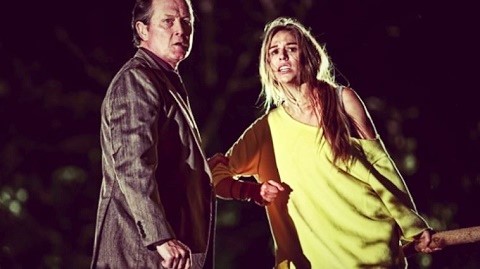
Adrienne (Kendra Leigh Timmins) and her pals have a little subterfuge planned for this weekend, for they are going up to the cabin in the forest outside Michigan to let their hair down and have fun without the prying eyes of any parents or authority figures to distract them. The year is 1984, but what they don’t know is that back in ’77 there was a terrible series of crimes committed which saw a bunch of people disappear in the countryside Adrienne and company are heading out for, and the Joad family, a group of cannibals, were blamed. By coincidence, one of the disappeared was her sister, and she has never been found, but she’s not interested in that tonight, first they must work out a way of getting out of the school dance…
Lost After Dark was yet another of the retro craze affecting genre movies in the twentieth century, and part of the large subset of eighties throwbacks which particularly seemed to affect horror movies. Of course, one drawback to conjuring that particular mood was that director Ian Kessner was shooting on digital, and that didn’t enjoy the same quality as film which the originals had been created on, so for a start there wasn’t quite the authenticity that you might have hoped for, no matter that there were celluloid flaws introduced artificially to imitate the appearance of a slightly worn print. Not only that, but he included the trick of having a reel missing as Robert Rodriguez had done in Grindhouse, and that didn’t convince either.
You could excuse this by pointing out that while there were endeavours to recreate the era of thirty years before this was made, it was consciously subverting a style that maybe more than many others had hard and fast rules to stick with. That it certainly did, which effectively concocted a plot that had more surprises than you might have anticipated, yet the fact remained there were more instances of Kessner and his co-writer Bo Ransdell staying with what had worked out for the slasher time and again, so perhaps they were not being as daring as they thought, or you might hope. Take the token black guy, Wesley (Stephan James), for an example of really needing to buck a certain trend, even if you were being ironic.
All those reservations aside, and you had to truly appreciate even a small attempt at doing something different to lose yourself in Lost After Dark, there was an obvious love for slashers that exhibited itself in the way the filmmakers knew them inside out. This wasn’t a masked killer effort where the villain would be revealed as someone known to the victims in the mystery format, as the murderer was Junior Joad, a survivor of the deadly family who supposedly had been dealt with some time before. Played by Tom Wiebe, he was your average bearded hillbilly maniac in overalls as seen in something like Madman or Just Before Dawn, an unstoppable force with a variety of ways of despatch, just to keep things interesting.
Although it took for around half the movie for him to actually begin offing the other characters, aside from the pre-titles sequence by way of whetting the appetite for the mayhem to come. Much of that first half was dedicated to rather more character-building than you might have expected, or indeed wanted given most of them would be dead soon, but it was interesting to see the bad girl show a sensitive side, or the good guy do the opposite, again shades of something a little deeper than much of what it paid homage to. Robert Patrick was the biggest name here, an imported star playing the principal, a ‘Nam vet who looks set to use his particular set of skills on Joad, imported because this was a Canadian movie which in itself was a neat call back to that nation’s film industry back in the eighties, or at least the less prestigious, in it for the money and tax breaks industry that churned out horrors such as this. This wasn’t going to change the world, it was too indebted to the past for that, but it was smart enough to be enjoyable for what it was. Music by Eric Allaman.