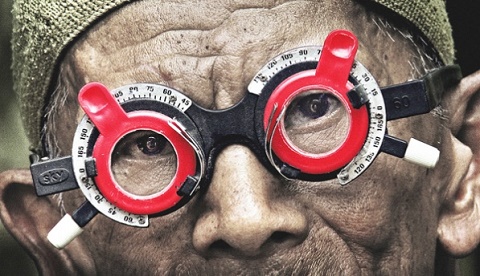
In 1965, there was a military coup in Indonesia where the military took power and executed a million people they claimed were Communists and therefore enemies of the Indonesian people, but the fact was they were more opponents of the military, intellectuals and activists who wanted more freedom and justice in their society. Nevertheless, ever since the government has been run by those murderers and they teach in schools that the mass slaughter of all those years before was desired by the populace and was not simply a method of securing and keeping control, as the threat of violence proves useful to be. One man, an optician, lost his brother to the attacks three years before he was born, and now he seeks to confront those still alive who caused his death…
As a sequel to The Act of Killing, there was always the temptation to view The Look of Silence as existing in the shadow of its predecessor since they took the same subject, and the fact remained there was nothing as arresting here as the climax to the first film, where one of the killers ends up retching in revulsion at his actions all those years ago when it finally hits home. They even adopted the same pattern, visiting various culpable men and accusing them from their own mouths as they were invited to explain themselves and their campaign of brutal victimisation, yet to use an old cliché, this time it was personal for director Joshua Oppenheimer concentrated not on the masses of dead, but on one in particular.
He was Adi, and all we learn about his current life is that he has a wife and young family, and that he looks after his very elderly parents; his father in particular is supposedly in his hundreds and essentially an invalid who has become confused about his situation, though his wife is more or less compos mentis and remembers all too well the time when their first son Ramli was taken away by the soldiers to be chopped into pieces. Oppenheimer showed footage of those who gave the orders for this execution to Adi, whose passive but emotionally deep expression speaks volumes as he tries to process the horror of what happened to his brother. By this point many of those who performed the atrocities were dead, but the director had caught them recounting their anecdotes.
And they are delivered like anecdotes, something reserved for after dinner conversation with a warm smile of reminiscence – remember those days when we hounded all those innocent people to their bloody deaths? You can tell they are still telling themselves they were perfectly justified in these horrendous crimes, which leaves the scenes where Adi politely but firmly brings up the subject to those who remain, and remain powerful for that matter, an interesting watch to say the least. You find yourself willing the murderers to feel guilty, to at least have some concept of the dreadful activities they have been excusing themselves of their actual consequences for all these decades, and thanks to Adi you can perceive that whenever he brings up the fact these men slaughtered his brother, it grows uncomfortable.
Not least because he is so calm about it, and says he is not out for revenge on them, as what the film represented was an acknowledgement for the massacres so that they would not happen again. When we see Adi’s children, especially his innocent young daughter, we worry for them as their father had obviously put himself in the firing line by agreeing to appear in the documentary – a government minister who ordered the attacks jovially admits them and when he twigs that he may not be coming across sympathetically he begins to inquire about where Adi lives, proving the terror was not over by any means (Adi refuses to tell him, and indeed moved far away once this was released to avoid any repercussions of his role here). All the way through a curiously placid yet sinister experience we are confronted with objectionable information – the United States basically sanctioned the million murders for business reasons – and people – drinking the blood of the victims was common, “so as not to go mad”, which begs the question aren’t you pretty insane in the first place to be doing that? The message emerges quickly and powerfully: don’t let history repeat itself.