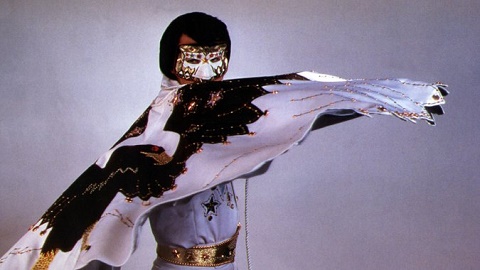
Jimmy Ellis always wanted to be a singer, but he had something about his voice that made it clear he both had the talent to succeed and a serious drawback in that drive for success. When Elvis Presley died in 1977, it was such a shock to his legions of fans that many simply refused to believe it had happened, which is why shortly after the rumours began to fly that he had faked his death for a quieter life out of the spotlight. But if that were the case, why would he stage a comeback under the moniker Orion, and sporting a mask to concoct a sense of mystery about his identity, not to mention recording a succession of albums of uninspired cover versions and originals? That was because Orion was actually Ellis…
The life of the impressionist is a curious one – the voice impressionist, that is, not the painter, as it is wholly reliant on the audience knowing who you are impersonating and allowing your own personality to become a strange, at times satirical amalgam of yourself and this other public persona. Jimmy Ellis, in that respect, had no other choice: when he sang he sounded practically identical to The King of Rock ‘n’ Roll, which was great if he wished to forge a showbiz career as a tribute act, but not so blessed if he wanted to find his own distinctive voice, largely because that voice effectively belonged to the most famous man in music when he was attempting to be an individual.
In director Jeanie Finlay’s documentary, she wove together a selection of archive footage, both audio and visual, to tell Ellis’s life story, along with some interviews from those who knew him at the time he was trying to make it. As if this was not odd enough, once he donned the mask and performed concerts after the King had passed on, a strong element of fantasy intruded into the audience’s reality as if they were willing him to be the authentic incarnation of their idol, and a running theme was of this disparity between what was really going on – essentially a cash-in item of mostly legal subterfuge – and what those involved wanted to be going on – for Ellis, becoming a superstar, for his fans, the idea that Elvis still lived.
If anything, Finlay didn’t quite exploit this enough, probably because the interviewees were happier to recount their anecdotes than analyse them too deeply, not further than lamenting over Ellis’s raw deal at any rate. He perhaps stuck too close to the lifestyle of Presley, not just a succession of one night stands from adoring groupies which is almost the most pathetic aspect of the tale, with both sides in that deal wanting for some status that they would never have, but also his very own Colonel Tom Parker. He was Shelby Singleton, who had bought Sun Records from Sam Phillips and was concentrating on squeezing as much profit out of that legendary name as he could; it was he who suggested Orion’s mask to sustain the enigma, lifted an author’s Presley pastiche biographical novel for the background details uncredited, and it was he who ordered Ellis about.
From rare tape recordings, we hear from the subject that he was less than pleased with the way this turned out, not least because while he was making a small amount of income from concerts and lots of them, it was Singleton who was making the big bucks with his Elvis soundalike, rushing a bunch of cash-in albums out with little regard to the wishes of Ellis himself. It was an old story, management riding roughshod over the talent, but its familiarity didn’t make it any less compelling, ironically because it was a sidebar to the life of Presley, and there was one element that you would have liked Finlay to make a lot more of. Ellis, as we can hear, performed a pitch perfect Elvis rendering time and again, and the reason for that may have been quite shocking: he may have been his illegitimate brother, given up for adoption as a baby so never knowing his true family of the Presleys. This fed into the Elvis mystique (he had a twin who died as an infant, so…) and would have been a killer hook to the documentary, but was a little squandered. Nevertheless, an engrossing story.