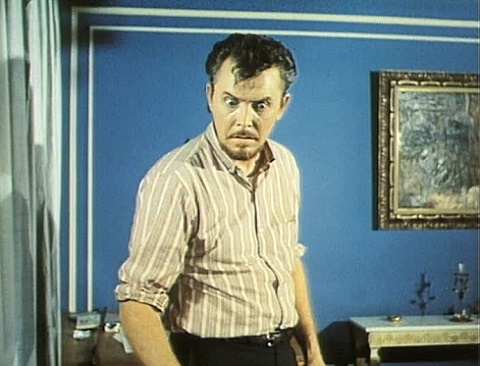
Bill (William Kerwin) is taking a trip to the Canadian wilderness with a lady friend, but as they draw up to shore in their small motorboat, along with his drawing utensils – he’s an artist – he picks up the harpoon gun as well. The girl sets about sitting on a rock and posing for him, and all goes well until she begins to move about whereupon Bill grows incredibly frustrated to the point of mania and sets aside his artwork to concentrate on spearing her through the chest with his harpoon. Unluckily for him, he has been spotted committing this act of coldblooded murder and must take to his heels across the countryside, pursued by a pair of justice-seekers…
William Kerwin was a jobbing actor with many supporting roles in film and television to his name, but what garnered him a minor cult following were the sleazy parts he took up in the nineteen-sixties, becoming friends with notorious trash auteur Herschel Gordon Lewis and starring in the likes of Blood Feast and Two Thousand Maniacs. One other movie Lewis made was Color Me Blood Red, which was all about a crazed artist who used actual bodily fluids in his paintings, and Playgirl Killer, also known as Decoy for Terror, acted as a companion piece to that, only nowhere near as violent. Indeed, it was relatively tame, with only its premise suggesting stronger stuff than reached the screen.
Kerwin was responsible, with his filmmaker brother Harry Kerwin, for the plot, which led up to a twist that appeared to be the sole reason for its existence, that punchline which saw Bill receive his inevitable comeuppance. Before that there was a large amount of what could only be termed padding, as we didn’t even get to see the murders aside from the attention-grabbing first one, and director Erick Santamaria, whose sole effort this was, was coy about showing his actresses in a state of undress as well, so hard luck exploitation fans. That said, this did not prevent Playgirl Killer from gather a following, mostly from those who caught it on late night television where it was appropriately shown as filler material.
Appropriate because most of the movie was filler material, though it did contain the camp quotient from the surprise guest star Neil Sedaka. Once we had established Bill was a psycho, we cut to a mansion house where rich girl Arlene (Jean Christopher) resided with her father and sister, the latter of whom was going out with Neil. He performed a tune about water bugs which seemed to be some kind of dance, and it was kind of fun to watch a bunch of Canadians frugging to the blandest rock ‘n’ roll imaginable, which came hot on the heels of a band doing their best impersonation of British Invasion acts to throw it into even naffer contrast. As we know, Sedaka was such a magnetic hunk of animal sexuality he would be considered a prime catch by any woman, so it is Arlene sets her sights on him.
Again, in a coy scene that featured her taking off her clothes illustrated by a closeup of her feet, and then off to seduce the celebrated middle of the road tunesmith she went. Just as we were settling in to regarding Sedaka in a new light, he promptly pissed off with the sister and, oh, yeah, remember Bill? Well he showed up, still on the run, and Arlene hired him as a handyman, though mostly to aggressively rub suntan lotion into her back. When he gets around to suggesting she model for him, we can see where this is going, and so it was with lots of pussyfooting around with shots of picturesque Canada and a noodling sax score punctuated with the red mist descending on the tortured artist’s mind whenever his subject moved a bit. He was trying to recreate a recurring dream, you see, and once you witness the three-dimensional achievement of that aim this did at least deliver a memorable ending. Not a good ending, but a memorable one to a film unlikely to satisfy anyone but the seasoned vintage trash aficionado.




 Display comments