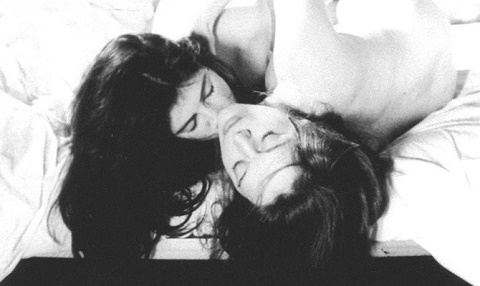
This young woman (Chantal Akerman) sits in a room having been left bereft now her lover has abandoned her, seemingly for good. To work through her emotions, she decides to stay there for as long as it takes to get her head back straight once again, setting herself small tasks such as painting the furniture blue, then green, then pushing it out of her environment altogether, leaving nothing there but a mattress to sleep on. The only foodstuff she has to eat is a bag of sugar which she partakes of in spoonfulls when she’s not penning a lengthy letter which she may never post. And so day turns to night turns to day…
Je Tu Il Elle was Akerman’s first feature as a director after a bunch of short subjects, therefore it may have been fitting that it resembled three shorts strung together to last nearly ninety minutes of grainy, black and white screen time. It announced her as a true original, not least for her treatment of female sexuality which had not been explored in such stark terms many times before, or not outside of the exploitation field and hardly ever by a female filmmaker. In the opening third, she lounged around a bare room with her pages scattered about and her bag of sugar never far away, the main drama occurring when she absent-mindedly spilled it; but she spent many of the scenes without her clothes on too.
Akerman never gave any of her three characters names, as the title suggested they were just “me”, “he” and “she”, with the “you” presumably being the audience who were taking this all in. That it all seemed so personal without actually giving that much away meant the experience was oddly cool when the direction might as well have been placing the trio under a microscope as part of some unexplained experiment, yet would heat up sexually whenever the carnal sequences were deployed. Until then, many viewers of the day, male viewers anyway, may have been surprised that women could feel lust and enjoy that sensual pleasure as much as their masculine counterparts, which made this so arresting.
That said, seeing as how much of what Akerman depicted could very easily be seen nowadays at the click of a mouse on the internet, it perhaps did not have the same impact that a director, especially one who wished to be taken seriously, would put herself in sex scenes, particularly the one which ended (or climaxed, if you wish) the film. That wasn’t with the “he”, who was a truck driver (Niels Arestrup in his debut) who picks up our heroine after her sugar runs out and she decides to strike out in search of her lover, though they did share a moment when she masturbates him in his cab; she also shared a beer with him and a few roadside café meals, including a humorous scene where they watch an episode of Cannon on television as if to perversely underline how far from the mainstream the director was operating.
Not that we saw the episode at all, just heard the soundtrack, another blank joke on the audience. There were in addition examples of Akerman’s trademark long takes, such as the monologue the trucker gave about his life he reflects upon in his post-orgasmic glow, but once the girl had reached her destination we finally met the lover (Claire Wauthion), and she didn’t appear hugely keen to hold a conversation, telling her almost immediately she wasn’t staying. Quite what that indicated in the context of what we had seen before, and what we were about to see with over ten minutes of naked grappling between the two actresses, was difficult to say, though we can be sure putting butter on your Nutella sandwich is a very bad idea (is that a Belgian custom?). It was as if by keeping us at a distance, refusing to guide us by the hand through her thoughts, that in spite of how much of herself she was displaying Akerman wished to keep something of herself to herself, allowing us to draw our own conclusions, and maybe relate to these utterly private moments, both emotional and physical.