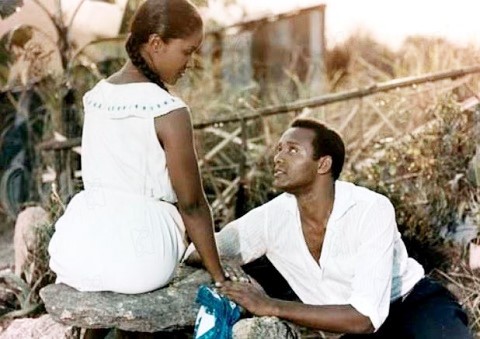
Eurydice (Marpessa Dawn) is a frightened woman, and because of that is fleeing her hometown to reach her cousin Serafina (Léa Garcia) on the outskirts of Rio de Janeiro where she lives on the high hills above the main city. She finds herself jumping at everything she sees as the place gears up for the carnival, but one kindly blind man helps her out by guiding her through the mayhem to the trolley car, which she boards after the driver, Orfeu (Breno Mello) invites her on among the already overcrowded passengers. When he gets to the terminus, the only other person left on the car is Eurydice, so he is moved to ask her if she is lost; she is, and he takes pity on her so helps her out…
Black Orpheus, or Orfeu Negro as it was called in its original version, was a sensation back in the late nineteen-fifties – all right, it wasn’t on the blockbuster level of certain other films, but for a work with no stars and an unfamiliar location to most of those watching, it certainly caught the imagination of the times, garlanded with awards including the Palme d’or at Cannes and the Best Foreign Language Film Academy Award. The story goes that not everyone in Brazil was impressed with how director Marcel Camus depicted them, possibly because as a Frenchman he was an outsider to their culture and there was a sense that you were watching the nation shown as a magical place rather than sticking to realism.
Indeed, this informed the view of Brazil for decades afterwards in the minds of non-Brazilians who saw the party that the carnival represented and believed they were the most fun-loving country on Earth, apparently not taking in the more serious side of Camus’s adaptation of the Greek myth of Orpheus and Eurydice. In that, the hero loses the love of his life and decides to venture to the underworld realm of Hades to rescue her; in doing so, he opens himself up to even more heartbreak when he didn’t have the faith in their romance that he really needed. In this film, Camus more or less stuck to the classical narrative, but adorned it with what could be termed “local colour” to make it all the more vivid.
Indeed, breaking out into exuberant dancing appeared to be the primary mode of self-expression here, often to the detriment of the plot if that was what you were here for. That said, the myth was so well-known that it wasn’t going to be added to thematically in any great detail, the director was faithful to it and it was more about crafting a selection of tones and moods, some of them joyful, others forbidding and menacing as Eurydice is pursued across the celebrations by a rejected suitor (Ademar Da Silva) who appropriately dresses as Death in a skeleton costume. That’s not all she has to worry about, as she falls in love with Orfeu much to the extreme displeasure of his self-appointed fiancée Mira (Lourdes de Oliveira) who threatens her with violence when she finds out.
So the odds are stacked against the lovers even if they were not acting out the legend, and it’s spoiling nothing to say among the singing and dancing there is an increasing sense of doom encroaching on them which after a fraught with danger middle section, resolves itself in Orfeu searching for Eurydice across the night, leading him to the hospital which represents Hades. In truth, you feel Camus could have done more to bolster the classical allusions as pretty much all we get is a big dog for Cerberus and a janitor for Charon, though the aching sense of loss is present, it’s just that after all that music and movement it’s rather swamped when those sequences were so colourful and bright. Nevertheless, Black Orpheus was a landmark in its way, setting out what appreciative audiences could expect from cinema not set in or hailing from The United States of America for a change, and as an experience it was hard to forget.