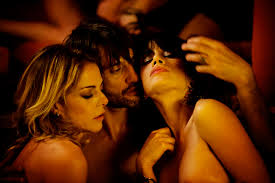
An attractive woman meets a somewhat sleazy-looking guy at a seedy motel somewhere in Milan. Moments later, at the lady's request, he has her bound and gagged on his bed. In preparation for the shag of a lifetime, the gentleman snorts a line of cocaine. Which is when an unseen assailant rams a ceremonial dagger straight through his throat. The captive woman screams, helpless as her lover is eviscerated on the floor. Inevitably she also succumbs to the maniac in the black leather coat with matching gloves. That's right, baby, it's giallo time! Meet sultry Lisa Boeri (Claudia Gerini). By day she's a high-flying career woman at a prestigious multinational corporation, trying her utmost to impress billionaire boss Mr. Roccaforte (Michele Placido). By night however Lisa dons red lipstick and a slinky short dress for kinky S&M three-ways with guys and girls at a secret sex club called Tulpa. Her after-hours recreation becomes a dangerous obsession. For as the string of increasingly grisly murders continue, Lisa discovers the victims were all her previous lovers. As a result Lisa becomes a reluctant sleuth and tries to catch the killer without exposing her own double-life.
Is it weird to find a film filled with kinky sex and gory violence oddly heartwarming? Now, before you recommend a good psychiatrist, hear me out. For the past two decades in Italy the giallo genre has been all but an endangered species aside from the odd lacklustre Dario Argento effort (a once great talent, sadly in terminal decline) or sporadic pastiche: e.g. Eyes of Crystal (2004). What is endearing about Tulpa – Perdizioni Mortali (Tulpa – Demon of Desire) is that it is a stylish throwback to the kind of deliciously twisted, sexy and outrageously convoluted horror-thrillers once tailored around glamorous scream queens like Edwige Fenech or Susan Scott. Which should come as no surprise given the script was co-written by genre veteran Dardano Sacchetti. If the film pales by comparison with the efforts of Belgian duo Hélène Cattet and Bruno Forzani and Britain's own Peter Strickland to rework familiar Euro-horror motifs as challenging works of art, it at least proves such devices can still work in contemporary cinema.
Co-writer and director Federico Zampaglione was a member of the Italian electro-folk pop group Tiromancino and evidently something of a giallo devotee. Among multiple duties behind the camera he also composed and performs the soundtrack which is as much a patchwork of Goblin, Bruno Nicolai and Ennio Morricone as the film itself evokes Deep Red (1975), All the Colours of the Dark (1972), The Iguana with a Tongue of Fire (1971), Crimes of the Black Cat (1971) and The Case of the Bloody Iris (1971) among several others. The murder set-pieces have that welcome surreal theatricality. While not achieving the same level of operatic intensity as vintage Argento, Tulpa shows Zampaglione as the equal of Sergio Martino. He skillfully orchestrates scenes of suspense and horror, retaining a sense of style without skimping on the splatter. Certainly the scene where a victim tied to a horse on a revolving merry-go-round has her face slashed by a bouquet of barbed wire till her eyeball pops out is pure Argento. Other colourful atrocities include a face melted with acid and a man with gaping chest wound shut in a coffin with live rats. As if that were not enough there is a sequence with Lisa chased by a hulking, lingerie-clad transsexual wielding a samurai sword!
Obviously viewers require a certain tolerance for camp hysteria and excess which should not prove a problem for most giallo fans. Helping matters is lead actress Claudia Gerini, more mature than the average giallo heroine yet no less alluring. Her admirably earnest performance carries us through a delirious plot riddled with ridiculous red herrings and lapses in logic. Set in a sterile, depopulated city where kinky liaisons alleviate an overwhelming sense of alienation, the film interestingly manages to turn the disadvantage of Italian actors struggling with English dialogue into a unique subtextual asset. While some of the dialogue is laughable (indeed skeletal Tibetan guru Nuot Arquint's cod mysticism drew such derisive laughter from the London FrightFest crowd, Zampaglione promptly re-cut the film to reduce his screen-time) the occasional stilted line adds to the theme of alienation. Note when Mr. Roccaforte gripes how globalization has forced him to speak with foreign associates in English, a language with which he is deeply uncomfortable. On the surface Tulpa seems to play a familiar game, reveling in nudity and sex while visiting gory retribution on practitioners of 'deviant' sexuality. Cinematographer Giuseppe Maio bathes the titular club in hellish reds that link desire with damnation. Yet a closer look reveals the plot, in particular the intriguing coda, can be read as more progressive than the conservative giallo norm since it implies sexual impulses do not debase our innate humanity. Whereas the killer filters their frustrated desires through moral outrage and violence, our heroine embraces freedom both in terms of exploring her sexual impulses and making her own choices in life.