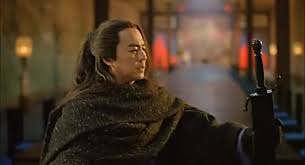
Crippled yet near-invincible swordsman in black Fu Hung Suet (Ti Lung) is a merciless killing machine driven by his mother to avenge his father's death. Yip Hoi (Frankie Chan) is a kind and lighthearted kung fu master fueled by compassion and empathy. These two very different warriors strike up an unusual, friendly rivalry when they arrive at Man Ma Hall. Here Fu aims to expose and kill famed martial arts master Ma Hung Kwan (Xu Huan-Shan) as the traitor who murdered his family. However, Ma's whip-wielding daughter Fong Ling (Fennie Yuen ) offers Yip sex if he kills Fu Hung Suet to save her dad. Although attracted to Fong, good guy Yip declines. So Fong cosies up to formidable swordsman Liu Siu Kai (Julian Cheung) who has no such scruples. In the meantime Fu falls in love with sweet yet self-loathing prostitute Tsui Long (Tsui Lam) not knowing he has mistaken her for the secret informant with whom he shared a night of passion in a dark room. That woman happens to be Ma's wife, Sum San Leong (Ida Chan). For her own reasons she also wants Ma dead. Wily old Ma proves not so easy to kill. He soon has Fu on the run from hired killers, rival swordsmen and bogus murder charges forcing a resourceful Yip Hoi and his plucky kung fu girl sidekick Ting Ting Lam (Anita Yuen) to unravel an elaborate mystery that hits close to home.
Sixteen years after playing the Clint Eastwood-styled grim avenger in the Shaw Brothers classic Pursuit of Vengeance (1977) Ti Lung reprised the role of Fu Hung Suet in this elaborate remake. At the time Hong Kong cinema was in the midst of a second golden age for period martial arts films sparked by the blockbusting success of two Tsui Hark productions: Once Upon a Time in China (1991) and Swordsman II: Invincible Asia (1992). Pretty much every film studio in the colony were cranking out high-flying wire fu fantasies which enabled soundtrack composer turned multi-hyphenate auteur Frankie Chan to rack up a hefty budget for his most sprawling and ambitious pet project. Filmed as a lavish epic in two parts with a combined running time of one-hundred and seventy-three minutes, A Warrior's Tragedy originally played theatres in a compromised one-hundred and ten minute cut. To confuse matters Chan's film was also released on video in a no-doubt confusing as hell ninety minute version as The Invincible Power of Kindness, an alternate title that more accurately reflects its pleasingly humanistic themes.
The central thrust of A Warrior's Tragedy is that revenge, the fuel that burns a hundred other kung fu movies, ruins lives. Although Fu is an upstanding, honorable sort his quest for justice yields innocent casualties as numerous others are caught in what proves a very tangled web. None more memorable than an amazing scene where an evil henchman goads a reluctant, horrified Fu to battle his entire family: siblings, grandparents, children and grandchildren. Come the gut-wrenching finale where Fu realizes his whole life was a lie the message hits home: hatred brings pain and disaster and only love and forgiveness can save lives. Of course the limb-lopping violence somewhat dilutes this theme and only a Hong Kong filmmaker would cap a heartfelt plea for love and tolerance with a tasteless, albeit hilarious gag that breaks the fourth wall.
When it comes to clarifying the absurdly convoluted plot Frankie Chan proves no match for Shaw Brothers wu xia mystery expert Chu Yuan. Not only does A Warrior's Tragedy take its own cool time to establish a definitive direction, characters pop out of nowhere while major plot twists unfurl with all the subtlety of an alien chest-burster. Where Chan succeeds is with the characterization and incidentals which are delightful, an offbeat mix of ominous atmospherics and jocular humour with flowery dialogue that evokes the witty wordplay of a vintage Chu Yuan wu xia mystery. In addition the acrobatic action sequences arranged by a near-dozen choreographers rank among the most delirious, inventive and often flat-out hilarious of the era: a hunchback conceals a projectile weapon inside his hump, Fu wields Tsui Long in battle like a human yo-yo, Yip Hoi and Ting Ting leap out of not one, not two but several exploding buildings rescuing a baby and three goats! All that and the finale involves a showdown with an invisible opponent. It is a kung fu film as concerned with relationships as much as action. Chan takes time to detail the grudging respect between two fundamentally decent men with radically different personalities as well as draw an affecting, tragic romance as Fu spurns Tsui Long because he can't quite understand how her emotional scars allow her to overlook his physical ones.
Some accused Frankie Chan of ego-tripping given he hogs the screen as the unflappable, intrepid kung fu sleuth who wins every fight and proves irresistible to women. Yet co-star Anita Yuen, then the hottest star in HK cinema, steals more than a few scenes with a hyper-manic turn as delightfully daffy Ting Ting Lam. Seemingly inspired by Brad Fiedel's score for Terminator 2: Judgment Day (1991), Roel A. Garcia's soundtrack provides an unlikely yet effect counterpoint to the spectacular cinematography of Ng Win-Git. Images of hordes of sword-wielding horsemen charging across the desert plains are worthy of Akira Kurosawa while the breakneck action reaches a delirious peak with Yip Hoi and Ting Ting trapped in abandoned town bombarded by warriors with chariot-mounted rocket-launchers. Did those even exist in ancient China?