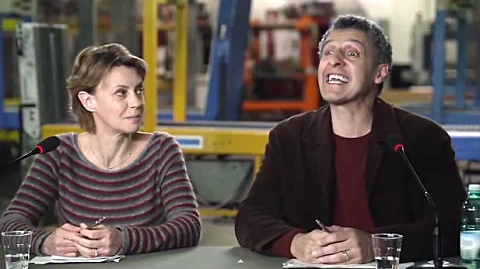
Margherita (Margherita Buy) is a film director currently making her latest opus, a socially relevant tale of an industrial dispute where a collection of factory workers are attempting to keep their place of work open in the face of management opposition. She is very keen to sustain this mood of up to the minute commentary on the state of the world in general, but something far more personal is preying on her mind, and that is the health of her elderly mother, Ada (Giulia Lazzarini) who is currently in hospital and as the doctor informs she and her brother Giovanni (Nanno Moretti), the old lady’s days are numbered as her body begins to break down. The family should really be prepared for this, but it’s proving difficult to cope with…
When writer and director Nanni Moretti was making the film previous to this, We Have a Pope, his own mother was suffering from a terminal condition, and being a talent who liked to bring his experience to his work, it inspired him to channel that sadness into a film by way of tribute. Quite why he made the director of the film within a film a woman rather than male wasn’t quite clear, but he was familiar with Buy as they had collaborated before and they enjoyed a good working relationship, which was clear from the empathetic performance she contributed to this project; maybe it was that a woman could convey the depth of emotion Moretti had gone through more effectively than a man?
That’s debatable, but it was true enough to observe the feeling of being lost in life even at the age where you’re supposed to have it all sussed and you’re settled into your middle age was very well portrayed by the lead actress, she didn’t go over the top and start with the hand-waving histrionics you might have expected from an Italian movie – the nation was rather notorious for getting sentimental about their mothers – and instead the scenes where she is brought close to breaking down had all the more impact because of that. But Buy was not alone, she had fine support not only from stage actress Lazzarini who put across the helplessness and increasing confusion that can arrive near the end, there was also an international star to contend with.
He was John Turturro, acting in English and Italian, who played funnily enough an international star, though you would hope he was better behaved and more relaxed than the diva he was asked to essay. The unlikely-named Barry Huggins (a nom de guerre?) is the celebrity brought in to appear in a key supporting role to raise the profile of Margherita’s movie, but he proves to be a nightmare, exactly what she doesn’t need at this time with the crisis going on at home. Well, sometimes he’s a nightmare, other times he’s genial, it’s just that the trying times happen when she is trying to direct him, with some very funny scenes as his ineptitude disrupts the shoot, and more worrying bits as this lack of professionalism starts getting to the director. That said, she does have some vague directions to offer.
Maybe not vague, precisely, but what she really wants from a story that appears to be a straightforward labour dispute account is more than she is able to bring out in her cast and crew, something about asking the actors to be the characters and themselves simultaneously to bring a more meta commentary to the premise. Quite why this would be necessary, never mind quite who the audience for this rather dry-looking film she’s making would be, is one of the weaker points of Mia Madre, yet you forgive it because the take on how a family copes with the deterioration and eventual demise of a loved one was plainly but insightfully brought to the screen. Buy in particular summed up all the abandonment and loss of direction such a life-shaking event could bring, as we see both her actual day to day trials and her dream life which adds a deadpan surrealism influencing a period that does indeed feel unreal when your foundations are rattled. We see the brother handling this better than his sister, and Margherita’s teenage daughter (Beatrice Mancini) turns lightning rod for the sadness in the situation, but in the end it was the director, both Moretti and Buy, who was responsible for a heartfelt testimonial.
[The Curzon Blu-ray has a nice print and the trailer as an extra.]