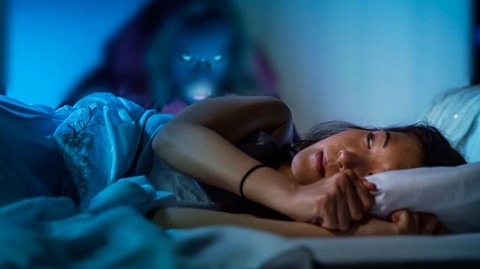
Let’s listen to some people’s accounts of the condition known as sleep paralysis. It occurs, as the name suggests, during sleep where the subject feels as if they are awake yet experience events as if they are still dreaming until they awaken for real. One man recalls his first encounter: he was five years old, and one night had just come out of the shower and been left alone in the living room of his parents’ house, idly watching the television until his mother returned from the bathroom, when he became aware the newsreader was talking to him. He was trying to catch the boy’s attention, and on doing so he informed him they would be back to see him, which terrified the child and brought his mother running to see what was happening, but he couldn’t explain in such a way that was convincing…
So was sleep paralysis and the hypnogogic imagery that accompanies the sufferers’ nights a medical condition, a symptom of stress or some sort of blurring of the edges of reality to allow some otherworldly entities a way into their existence for the duration of the nightmare? Don’t expect any hard and fast answers from director Rodney Ascher’s documentary The Nightmare, partly because there just weren’t any to be had as science did not fully understand the processes of what was occurring in the minds of the afflicted, but more than that because he was intent on recreating the nightmares in staged scenes with actors and special effects to bring them to life in a manner that was true to his subject’s accounts.
As far as that went, it could be judged a fairly impressive accomplishment, as the sequences where shadowmen or other creatures disrupted the reality were very nicely handled, as if Ascher was champing at the bit to make a horror movie of his own yet didn’t trust himself to make up his own plot, therefore borrowed a selection from eight people willing to share their own dreams with him. A parade of bizarre figures roamed before the camera, grinning, attacking, looming right up to their victim’s faces, and of course sitting on their chests just as the night hag of olden days used to do. There was a sense that fictional horror films like A Nightmare on Elm Street or Insidious and alien abduction science fiction were now informing the experience more than some old witchy woman invading the bedroom.
But one film referenced was Communion, the odd movie of sci-fi author Whitley Streiber’s supposedly true sleep paralysis episodes that led him to believe he was visited by aliens from outer space or another dimension, which not only suggested that this was a phenomenon that fed on itself to propagate, but that the visuals adapted themselves over time to stay relevant: it was notable not one of the interviewees mentioned a traditional night hag that someone from medieval times might recognise as a state of troubled sleep, and instead they have moved on to terrors more informed by pop culture. Many of the recreations here had the potential to be adapted into twenty-first century fright flicks, especially those which relied on supernatural jump scares for their effect, so it’s no wonder something like Insidious is mentioned as seeming accurate.
Nevertheless, even if you did think that there was a scientific explanation, as many of the subjects do, there were some very freaky stories related in The Nightmare, with strange communications from the tormentors and the not quite believable idea that merely hearing about the experience from a sufferer could trigger it in the listener. It was true that most people go through a strange sleep passage at least once in their lives, but almost everyone chalked it up to a quirk of their slumbering mind, though there were folks here speaking as if the figures they saw at night were genuine, living, breathing entities. One woman turned to religion to cast out her “demons”, and became a Born Again Christian, one man believes he is battling enemies from another dimension and the internet fuels that, placing significance on what may simply be an elaborate set of dream circumstances because at least it makes some kind of narrative sense instead of a random bunch of scary stuff. Ascher did try to highlight the connections between the tales, but the fact remained, like alien abductions, they were different enough to be very personal to the dreamer. Needless to say, if other people’s dreams didn’t interest you, stay well away. Music by Jonathan Snipes.