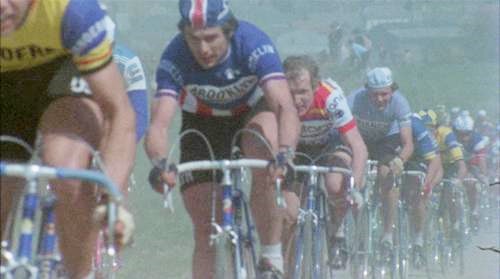
The Paris-Roubaix cycle race has been run since 1896, and has become notorious across the world of the sport as perhaps the toughest one day event to be staged in its history. Now it is April 1976, the eightieth anniversary of the contest not counting the war years when no race was held, and the fans want to see whether the most famous rider for decades, Eddy Merckx, can reclaim the trophy after a spell where his success has tailed off somewhat. But he is not the only favourite, for another Belgian, Roger de Vlaeminck, is generating a lot of interest, as indeed many Belgians are, they being the nation who have won the event more than any other…
Jørgen Leth may be better known now for the film he made with Lars von Trier called The Five Obstructions, where the great Danish documentarian was invited to remake what von Trier was of the opinion was one of the finest short films of all time, only five times and with various “obstructions” to truly challenge him. Aside from that, he would be better recalled for this cycling work where he and his crew showed up with the rest of the press contingent to record the ’76 race from the north of Paris along increasingly harsh terrain for the best part of a day, or daylight hours at any rate. It had gone down in history among aficionados as a fascinating insight into what the race was like at that point in time.
In 1976, Europe was labouring under the hottest summer it had seen in decades, and that was just getting underway when the contest was staged, which meant what was more traditionally known for its muddy conditions, so much so that it was often impossible to actually cycle in them (as we see in archive footage), were replaced with quite the opposite. No chill in the air here, aside from the very early points, as the day went on it grew progressively drier and dustier – you watch the shots of the cyclists and their entourage emerging from clouds of dirt and wonder how they were ever able to follow the course, never mind make any headway across those famous cobbled roads which must be deeply uncomfortable to travel over.
But that was the whole impetus for competing, how difficult it was, and when even finishing last was some sort of achievement because at least you had made it to the finish line the impression was one of physical endurance rather than skill, even strategic cunning. Yet there was a psychological element Leth was keen to emphasise, with tactics on display from the beginning to the end. Now Merckx may be the biggest draw to A Sunday in Hell for to this day he is possibly the most famous Belgian rider who ever lived, though there was some poignancy in seeing Marc Demeyer, one of the most promising riders at the time, who went on to a notable career sadly all the more notable for his early demise of a heart attack aged just thirty-one.
With all that in mind, for the outsider to the sport you would have no way of knowing whether this was a classic race or not, so context was a little lacking when it seemed the film took it for granted you had some familiarity with the endeavour, especially in the narration in the English language version by cycling journalist David Saunders, which would be practically the sole example of that in the whole movie, so if you didn’t speak the competitors’ mother tongue then you might be lost in not being allowed into their sphere. That said, it does come across as a particularly insular experience to be part of; you do note the final message that there’s no rest for these men, they will be back in the saddle, literally, the next week just as they had been the previous week, and so on until they retire. There are distractions such as a protest by the sponsor’s workers which disrupts things twice, and pile ups and crashes which see blood spilled, but this was all part of the physical test for which the word “gruelling” was invented.