Tun (Ananda Everingham) is hanging out with his friends and his girlfriend Jane (Natthaweeranuch Thongmee) in a restaurant, celebrating the student days that are very much a part of their lives still, but as the evening winds down, it is time to hit the road, and Jane, who has not been downing the alcohol all night, offers to drive Tun back to their accommodation. On the way they chat as the car speeds through the darkness, but it only takes a split second for Jane’s eyes to leave the street ahead for someone to walk straight out in front of the vehicle and hit them. The car comes to a halt and they look around to see an inert body lying some distance away; Jane is about to get out and investigate but Tun urges her to drive on…
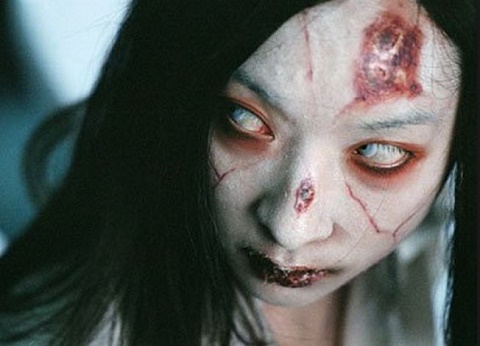
What they would have found should they have actually gone over to see the body might have been interesting, but Shutter was a story about guilt, and male guilt at that, while also belonging to the prolific genre of Asian cinema where horrors would be visited upon the characters by spooky young ladies who sport white dresses and whose long, black hair covers their faces. They didn’t seem like much to look at, but their relentlessness and habit of popping up at the most unsettling times made them a big hit with chiller audiences both in Asia and further afield, where this strain of horror spawned a cult following. That said, to the uninitiated there was a sense that if you’d seen one of these, you’d more or less seen them all.
The more seasoned aficionado would be able to identify the differences between the much put upon ghost ladies of Ringu or Ju-On, to name but two franchises, and Shutter wasn’t one to buck any trends, it was a pretty straight ahead spooky show that stood out from the crowd by virtue of the co-directors Banjong Pisanthanakun and Parkpoom Wongpoom and their flair for a simple but effective scare. Even those feeling jaded by this format might find themselves giving a start or even being creeped out by the ideas the supposed villainess employed to visit her revenge on those who had wronged her, and that theme that if you had made someone your victim then you had effectively damned yourself was a potent one.
All the more potent if you really had bullied someone to the grave, one supposes, yet since everyone feels guilty about something once in a while, if not every day of your life depending on what you’d done, Shutter tapped into that fear of punishment for a deliberate wrongdoing that is innate in the human psychology. As it turns out, Tun is the one who should be feeling the guilt, though we don’t find out exactly why until almost the end, but the fact is when his pals start to be persecuted to their eventual demises, it seems as if he’s next on the list of Natre (Achita Sikamana), who starts appearing in various photographs the shutterbug has been snapping recently. The notion that the camera never lies was underlined by the unease ghost pictures can bring, and that was part of the director’s grand plan.
Even to the extent of using actual ghost photographs to illustrate the fictional ones Tun takes are more authentic, though the fact remained they were very easy to fake and if he had been able to explain them away airily as glitches or deliberate shams then it wouldn’t have been half the film it was. Nevertheless, that worry the spirit world can show through, no matter that one character does indeed provide explanations that sound perfectly valid, was central to the fright factor, and when it came to movies like this the best bet was to just go with it no matter how sceptical or accepting you were of the phenomena the directors exploited. They came up with some very neat setpieces, maybe nothing that hadn’t been seen before but for all that well deployed and with a clever final twist that came across as a very Asian in its presentation, and all the better for it. And yet it all came with that stern warning: behave yourself lest something worse than what you have visited upon someone be visited back upon you a hundredfold. Music by Chatchai Pongprapaphan.