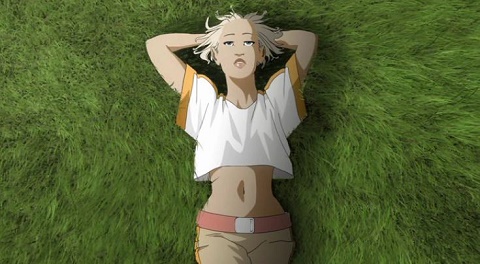
Edit (voiced by Sanda Knezevic) is a student in the Belgrade of 2074, but she’s not a particularly successful student, having failed her past few exams and now in danger of being booted off her course if she doesn’t make the grade next time. She does have a lot on her mind, as her pet died recently and she’s upset about that, not to mention her family life at home could be better with many disagreements with her forceful mother – who is only distracted by South American soap operas on television. Her boyfriend Bojan (Nikola Djuricko) isn’t much help, more interested in robot sex dolls than her, but technology might assist Edit’s plight if she can get a memory implant…
Serbia might not be the first place the average viewer thinks of when it comes to animation, never mind science fiction, but its thriving comic book industry brought up Aleksa Gajic, who set about bringing one of his works to the screen, taking charge of almost every duty on the project to make sure it was all crafted to his specifications. The results won some acclaim, especially in the animation world from those well-disposed to watching Japanese efforts in that style, which this was patently indebted to, with some comparing it favourably to the benchmark Ghost in the Shell. If it didn’t quite hit those heights of regard, Gajic was obviously in possession of a fair degree of talent, and more than that, ambition.
In fact, so dense with the technological, theoretical side of the plot was Technotise that you imagine many a casual viewer would give up on it well before the end, merely allowing the succession of coolly designed imagery to pass before their eyes and leave it at that. It was true enough this was more keen on its depiction of science fiction tropes like artificial intelligence than it was on making the characters more three dimensional, when most of that would be in the service of the visuals, and for the most part their concerns were more to do with the fantastical than the everyday worries the majority of the potential audience might well have been more interested in. For the most part, it wasn’t relatable.
Sure, if you are or have ever been a student for whom passing that big exam was a major priority you may sympathise with Edit, but it’s doubtful you would continue to relate when the memory implant develops a mind and will of its own and begins to take her over, in a curiously benevolent fashion. She can see him as a grey haired but well-proportioned older gentleman, leaving the sequence where he seduces her by making it feel as if her pleasure centres are going into overdrive more the product of Bojan and his boorish friends’ point of view than anything vital to the plot, as if Gajic was adding in a bit of sexual content to justify its adult-oriented themes, only not with the courage to explore the more serious implications.
Implications of artificial intelligence and nanotechnology that was, not a fresh subject in 2009 but that didn’t mean it couldn’t be approached in fresh ways, which left Gajic’s striking visuals to carry much of the interest. As a film, it was on the lower end of the budget scale which excused the frequently Flash-animated appearance of many of the cartoons of its era, though if you preferred something slicker, and let’s face it, more expensive, Technotise was by no means ugly to look at. It did, however, resemble a bunch of comic book frames brought to life, which might not be everyone’s idea of what they wanted in a film, and when the narrative was so overinvolved a lot did rest on how enjoyable the viewer was finding these images. As for that storyline, Edit was a proactive heroine as she worked out what was happening to her, gathering her pals to help out, yet for the last act spent much of the time unconscious, rather frustrating when we were supposed to have invested so much in her actions. For what it was, it was decent enough. Music by Boris Furduj and Slobodan Strumberger.