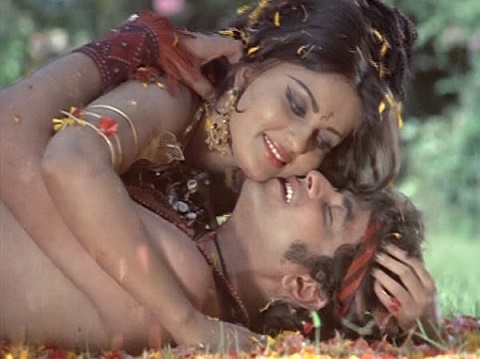
Professor Vijay (Sunil Dutt) is out driving in the forest when he happens to spot a man (Jeetendra) being attacked by a vulture, and steps in to intervene with a well-aimed bullet from his rifle. The man is very thankful, and when asked what he is doing out here in the middle of nowhere, he replies he is here to meet with his snake girlfriend, which is not the answer Vijay was expecting. Or was it? He has been studying snake spirits so when the man transforms into a cobra he is taken aback, but he has heard of such phenomena, and observes as the animal is joined by another, who turns out to be Nagin (Reena Roy), and they sing a ballad to one another, lost in their love. However, Vijay has accidentally set in motion their parting…
Horror isn’t a genre often associated with Bollywood, but there have been a few instances of shockers from the Indian film industry, and Nagin was one from the nineteen-seventies that used its villainess’s shapeshifting abilities as an excuse to cast a bunch of attractive actresses to pose as her in disguise. Sort of a method director Rajkumar Kohli implemented to provide value for money for his audience, or those in the audience seeking lovely ladies to feast their eyes on, call it an Indian version of a Robert Rodriguez flick in that way. Of course, there were also some strapping blokes for those of the other persuasion, and they made up the list of victims for Nagin to exert her lust for vengeance upon.
The reason? When Vijay asked the males in his circle of family and friends if they wanted to see the snake lady and gentleman, they jump at the chance and head off to the forest to get a peek, but alas, one of them brought his gun, and though there was no motive for this other than setting the plot in motion he unintentionally shoots the snake chap dead. Nagin is predictably peeved at this turn of events, and vows to track each of the five men down and execute them for ruining her chance at romance, which she more or less does over the course of the next two hours, though that rather repetitive plotting was broken up by the inevitable songs. One of them, a dance number which featured a huge group getting on down, went on to be more celebrated then the movie itself.
But back at the storyline, Nagin is cutting a swathe while they are cutting a rug, assisted by some of the shakiest special effects you ever did see, mostly consisting of Nagin transforming from snake form to human and back again with use of crude animation. Naturally, while nobody was going to be blown away by such sights now, if indeed they were back then, they did contribute to the overall kitsch of the experience, and you found yourself looking forward to the sequences where the actress would be replaced by an uninterested-looking reptile. That said, there were bits where it chased characters, often showing off its ability to fly (!), including one outdoor pursuit where it looks very easy to outrun yet managed to hound its quarry off a cliff.
It would be interesting to learn how seriously contemporary Bollywood audiences would react to this film, were they chuckling along, tapping their feet with the tunes and so forth, or was anybody genuinely scared by the thought of a snake lady fooling them into believing they were with someone they loved, or could at least think about getting close to, then suddenly turning on them? It would be easy to perceive a fear of women in Nagin, but aside from the title character the other females were portrayed as either perfectly sensible or supportive, so that argument didn’t really hold water. It was more a fear of the supernatural that drove the narrative, and considering snakes kill plenty of victims in India even to this day, adding an otherworldly, even demonic, aspect to their wariness of the creatures might have proved pretty potent should you have had a close encounter with them. Adding a warning against atheism – you can guess how that character ends up, yup, finds God then becomes another victim – was not enough to make this convincing, but the grand finale atop a tall apartment block with Vijay and his infant niece menaced by Nagin was hilariously difficult to forget.