This is our world, where the four winds blow, known as the trade winds for their contribution to sending the sailing ships across the oceans, but they also had a more natural purpose, to bring the rain from over the water to the land. However, on the Pacific coast of North America there was a huge mountain barrier to that which created the deserts stretching for miles, and it is that barren region we will be looking at. But how barren is it? In fact, the deserts are teeming with life, from the smallest insect or arachnid to larger mammals and birds, not to mention a wide variety of reptiles such as snakes. Just how populated this area is will be something we will witness over the next hour or so…
The Living Desert was not Disney’s first nature documentary, they had made shorter subjects in the wake of the success of Bambi, but it was the first to be around feature length, padded out with a twenty minute cartoon to leave it at ninety minutes of entertainment. It’s easy to forget what a novelty this was: full colour depictions of flora and fauna, with close-ups and genuine drama if you were sufficiently invested in the creatures’ lives, which director James Algar was all too happy for the audience to be, you could tell it was geared towards that fairly blatantly. That’s where the issues later viewers began to take with the Disney’s True Life Tales arose, for the suspicion the scenes were largely staged was difficult to shift.
You can pin the blame for that not here, but on the controversy surrounding a later True Life Tale, White Wilderness which orchestrated a mass lemming suicide into a river: lemmings don’t actually commit suicide, but the filmmakers made it appear as if they did, and ever since that truth got out the studio’s documentaries, from this decade anyway, have been viewed with an extremely critical eye. Also, you can tell many of the confrontations seen in The Living Desert were set up by the director, so when the animals fight this is not something the camera happened to be around to capture, they were brought together specifically for them to behave in that way for dramatic purposes. That said, this film was able to excuse itself.
That’s because nothing that happens here, unlike the lemming debacle, would have happened unnaturally, the creatures behaved perfectly normally from the battling tortoises to the wasp getting the better of a tarantula, they were merely recording what naturalists had observed for some time. If anything, they played down the more violent aspects, as no matter how many small furry animals we saw in peril, none of them were actually killed or eaten by the predators aside from a bat which was swarming with its fellow rodents and anyway, that was viewed from a distance, we were not privy to the hawk which caught it tearing it apart for its evening repast. So if you wanted to watch the cuter critters go about their daily – and nightly – business, you were more than catered for by this.
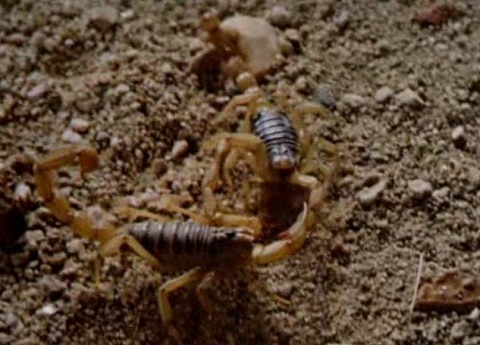
On the other hand, Algar took great delight in the encounters of the uglier beasts, so those large spiders did show up a lot, and a toad or two would help themselves to the creepy-crawlies their tongues could reach: this was by no means as sanitised as its reputation. There was a sequence that continues to have the critics rolling their eyes, and that was when a couple of scorpions performing their mating dance was manipulated to make it look like a hoedown, with the narrator (Winston Hibler, like Algar a company man through and through) doing the accompanying lyrics, but in the main it was no worse than what Johnny Morris would do narrating Tales from the River Bank or his Animal Magic skits later on. And if you don’t think nature documentaries made these days don’t at least include a little manipulation, you would be naïve, it’s mostly this example’s age and delivery that had it held up as crass. In reality, it’s respectful, the footage still compels, and it stands as something of an achievement in its pioneering of the form.
I grew up in an age when Disney's True Life Adventures were a staple of summer holiday viewing. Controversy aside, I think they stand up as a valuable introduction to nature for children. By contrast I do worry how many kids Steve Irwin inspired to go out and rugby tackle any animal they could find!




 Display comments