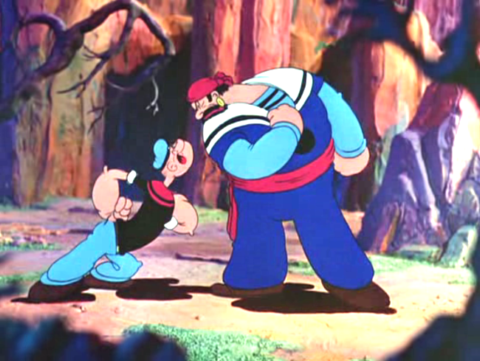
Sindbad the Sailor (voiced by Gus Wickie) lives on an island in the middle of the ocean on the back of a whale, or so he claims, and is a boastful sort who likes to sing of his exploits as the "most remarkable, extraordinary fellow" while his menagerie of exotic animals which he has collected over the years join in on the chorus. He keeps these creatures in line with a regular, well-placed biff to the head, so his lions, gorillas and dragons will never try to best him, knowing he is too strong, and even his two-headed monster and giant Rokh, a huge bird, follow his every command. However one morning when Sindbad is singing his song, he is interrupted by a voice drifting over the sea: Popeye the Sailor (Jack Mercer)!
Popeye the Sailor's song is far better known than Sindbad's anyway, even today, such is its catchiness, and he used it to herald his every appearance in the Fleischer Brothers' cartoons which starred him, making him immediately recognisable: it was like an advertising jingle, and just as in the world of commerce, the world of animation in the nineteen-thirties was one of fierce rivalry. The Fleischers' main rival was Walt Disney, and as we now are well aware they may have won various battles, but Disney won the war as his company endured into the twenty-first century while they struggled in the forties and eventually fell away.
But those battles they succeeded in were worthy, including producing the first sound cartoon which even to this day Disney gets the credit for instead, but one of their most notable achievements was the run of three Technicolor Popeye cartoons of the late thirties. This was the first, twice the length of the black and white one reelers that had gone before and plonking the familiar characters down in a fable, as if to indicate to the audience that this was something special. Popeye, Olive Oyl (voiced by Mae Questel, also the voice of Betty Boop) and Bluto would adopt different roles in each of the shorts, but they were placed in a milieu recognisable to contemporary audiences.
So Popeye would not show up in medieval times as a knight, for example, as a regular Warner Bros. character might, he had to be grounded in some familiar reality even as the adventures he got involved with featured outlandish violence of the sort superheroes get stuck into in blockbusters, only with more of a sense of humour. The Fleischers were taking a gamble with these colour efforts and casting Bluto as Sindbad was one thing, yet having him kidnap Olive was certainly the kind of activity he would regularly get up to before, as he does here. This gamble paved the way for feature length cartoons with the Disney Snow White and the Seven Dwarfs, but these guys never took to the longer format as well as their opponents did, which some saw as the reason they did not last.
They undoubtedly had popular characters with this line of animation, and all of it hand drawn, mixed with so-called tabletop backgrounds, actual models the characters could be placed over for the illusion of depth; director Dave Fleischer had used that before in the seven minute works, but the process really came into its own in these colour efforts, rendering them some of the best looking of their era. If you thought you'd prefer to see Popeye and company in a more traditional milieu, then you were not going to get on with the fairy tale versions, though audiences of the day loved these and flocked to them, in their way the signalling what much loved characters would do when they were taken out of the short form and into a production lasting over an hour, which may be a mixed blessing: Bugs Bunny playing sci-fi basketball in Space Jam was not exactly satisfying. Here, however, the Fleischers got it right, since no matter the plot, flimsy as it was, they were still the same cartoons, Popeye still sounded like Popeye, and the jokes were as surreal as ever. The eye-catching colour process was the icing on the cake.
As a child I loved this movie and it holds up remarkably well. It was a prestigious experimental venture for the Fleischer brothers. The juxtaposition of cel animated characters against three-dimensional backdrops remains striking to this day. I don't know why more animators don't use this technique.
In a lot of ways the reason Fleischer studio did not endure is because the brothers were their own worst enemies. Max preferred to potter away on his inventions and didn't want to be bothered with niceties like story or developing characters. When asked to animate Superman he actually quoted producers a huge fee banking that they would not agree to pay so he wouldn't have to make the cartoons! Many animators maintain that Dave Fleischer, while undoubtedly a creative genius, never knew went to leave well enough alone. He'd constantly add gags or re-think stories until costs of the average Popeye cartoon went through the roof. Then there's the fact there was little love lost between Max and Dave.
According to Richard Fleischer's autobiography one of the last things Max did on his death bed was point to a picture of Walt Disney and mouth the words: "Son of a bitch."
Posted by:
Graeme Clark
Date:
19 May 2014
Well, that's the difference between an obsessive perfectionist and a canny businessman, isn't it? The Fleischer Popeye cartoons are among the best animated of all time, just exquisitely crafted and they don't forget to be funny either: I vividly recall the giant roast chicken gag from this from watching it on TV as a child. I suppose we should be grateful they were able to complete as much as they did before it all went wrong.
I didn't know that deathbed anecdote! Funny and a little sad.
Posted by:
Andrew Pragasam
Date:
20 May 2014
Apparently Max regularly referred to Walt Disney as an S.O.B. when Richard Fleischer was growing up. However, when Disney hired Richard to direct 20,000 Leagues Under the Sea he invited Max along and gave him a tour of his studio. Disney had a lot of respect for him as an artist and was saddened to see him at such a low ebb. He offered Max a job which he turned down and at one point in the Sixties even paid his medical bills. All of which makes that anecdote even sadder.




 Display comments