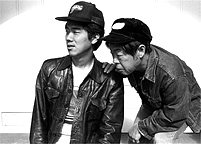
Middle-aged Jo (Wood Moy) and young Steve (Marc Hayashi) are a couple of Chinatown cab drivers seeking the elusive Chan Hung, a recent immigrant from Taiwan who has disappeared along with the four-thousand dollars they gave him to secure them a cab license. Their search brings them into contact with a variety of intriguing characters providing contradictory answers to complex questions about cultural identity, politics, race and the ongoing problems faced by Chinese-Americans trying to assimilate into American society.
Shot in film noir black and white, Chan Is Missing was the breakthrough feature for Chinese-American indie auteur Wayne Wang several years after co-directing the obscure A Man, a Woman, and a Killer (1975). With cod-gumshoe narration, gags alluding to Charlie Chan and a third act murder mystery twist that foreshadows Wang’s later excursion into neo-noir: Slam Dance (1987), the film is part spoof detective story but also among the first American movies to present Chinese characters as believably faceted human beings rather than crude caricatures. It also alludes to deeper themes relating to the Chinese-American experience as a whole.
Rather than simply a missing person, the ephemeral Chan Hung becomes an allegorical stand-in for all Chinese-Americans during an uncertain era. He is the square peg that can’t quite fit into the round hole of mainstream Reagan-era America. The image of the clueless, fish-out-of-water immigrant Chan presents to the outside world, proves at odds with what Jo knows of him as an educated, upwardly mobile man who helped develop the world’s first Chinese language word processor. While Jo can empathise with Chan’s alienation and uncertainty in America, Steve believes cultural identity is no longer an issue in this day and age. He just wants his money back.
The film touches on the generation gap, cultural differences and the problems of integration with great humour and heart but can be a difficult watch for those with less patience for indie eccentricities. There are some flubbed lines, Robert Altman-esque overlapping dialogue, inconsistent semi-improvised performances and sections where the dialogue track is deliberately drowned out by background music, as in the scene where Jo politely interrogates Mrs. Chan Hung (Ellen Yeung) while her daughter Jenny (Emily Woo Yamasaki) blares rock music from her room. All of which could prove frustrating for those expecting a more linear mystery with a clear-cut resolution, but Wang makes such quirks into endearing assets. His fly-on-the-wall style allows viewers to eavesdrop on some lively, often thought-provoking debate, side-stepping the question of where exactly Chan Hung has gone. Ultimately that is not the issue. Far from a mystery without a resolution, the film is the cinematic equivalent of a Chinese lantern proverb, arguing that what is not there has just as much meaning as what is there. Wang applies this outlook to the question of Chinese-American identity, concluding that something that seems so elusive, so hard to pin down, is really staring everyone in the face, just like all the locals strolling through Chinatown each and every day.
This may be a small film but it's not inconsequential, it has a really nice texture to it that isn't amateurish exactly, but represents the way indie cinema was undergoing a transition in the eighties from John Sayles at the start to Steven Soderbergh at the end. That it offers an insight into a culture not often seen in depth back then only makes it richer.




 Display comments