François (Jean-Claude Drouot) leads an idyllic life in the country with his lovely wife Thérèse (real-life spouse Claire Drouot) and their adorable young children, Gisou (Sandrine Drouot) and Olivier (Olivier Drouot). A devoted family man, happy working as a carpenter alongside his older brother, he seems to have it all. But that does not stop François falling in love with Emilie (Marie-France Boyer), an alluring young woman who works at the local post office. And Emilie is just as much in love with him. While François still loves Thérèse and has no intention of ever leaving her, his affair with Emilie enriches his life to the point where he naively believes he can share his love with two women.
Agnès Varda’s third feature film - her first in colour - scandalized the French bourgeoisie with its sympathetic depiction of adultery yet is far from the simplistic advocate of free love that detractors make it out to be. Beneath its deceptively tranquil surface, Le Bonheur ranks among the most provocative, unsettling, fascinatingly perverse French Nouvelle Vague films of the Sixties. Its title translates as “Happiness”, for that is indeed the theme: the ephemeral and often elusive nature of physical and spiritual bliss. “Happiness is, perhaps, submission to the natural order of things”, remarks someone in a film the characters watch on television in an early scene, a statement far removed from the course taken by our antihero, François.
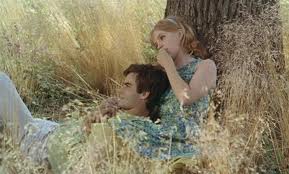
The film opens on a picture perfect rural idyll as François and Thérèse relax in a field of flowers with their two beautiful children. It is a veritable Eden yet whilst viewers may be anticipating a serpent to slither along and shatter this paradise, the source of the inevitable downfall does not stem solely from the ebullient Emilie. Rather her affair with François is simply symptomatic of his own misguided belief that “happiness adds up, happiness accumulates.” Put simply François seems to believe that what feels good for him will invariably have benevolent consequences for his family and the world at large. He does not perceive his relationship with Emilie as a tawdry affair but simply sharing his love with someone else. Equally François comes to believe the satisfaction derived from Emilie spurs him on to being a more attentive husband and father.
Exquisitely shot by cinematographer Claude Beausoleil, La Bonheur’s surface naturalism belies a vivid psychological use of colour bound with nature and the changing seasons. Thérèse is of the earth, endlessly patient, tender, nurturing and sweet to the point where François’ infidelity appears almost unfathomable. Whereas Emilie is of the air, quite literally breezy, ephemeral and exciting. She encourages François to indulge his urges without fear of consequences. Yet Emilie is not drawn as some poisonous femme fatale, simply a happy-go-lucky young woman. Similarly, François does not emerge a bad man though he is undoubtedly a selfish one. At best naive, at worst hopelessly deluded.
Like Nouvelle Vague contemporary Jean-Luc Godard, Varda is less than subtle in her use of symbolic montage but her vibrant editing keeps the viewer transfixed throughout a narrative where little actually happens until the masterfully disorientating third act. Without lapsing into soap opera histrionics, the film is neatly subversive, fading out on what some might interpret as a happy ending which leaves it all the more profoundly unsettling. Jean-Michel Dafaye supplies a score every bit as lovely as Varda’s vibrant colour palette.
Unsettling is the word for it, it made me think of one of those unbowdlerised fairy tales with the ending that leaves you with mixed feelings. It's like nature tyrannically rejects the three-way relationship and acts violently to re-establish its balance. It's difficult to think of a film that does what this achieves so effectively, and it all came about because Varda loved to go on picnics!




 Display comments