It is the eighteenth century, and one Spanish monk, Friar Ambrosio (Vincent Cassel) has been impressing everyone in his province for his piety and the force of his preaching. He was originally found on the steps of the monastery as a baby, and taken in where he was brought up by the monks there, enthusiastically taking part in every religious ceremony and lapping up the teachings with gusto. Now he has what can best be described as a following, with many keen for him to take their confession, but one day he hears from a particularly debauched individual...
Who just might be the Devil himself in this, the third big screen adaptation of Matthew Lewis's celebrated gothic novel, which was oddly from director Dominik Moll, not a name you'd instantly associate with historical literature, even the scandalous kind as Lewis's was. Derided in its day by everyone from the Church to Lord Byron, the feverish prose has inspired many artists wishing to push at the boundaries of what was acceptable, and though some have dismissed it as an extended masturbation fantasy, others preferred to look at it as an extreme example of how far it was possible to go with literature - all of which might lead you to expect Moll's version as something pretty out there.
If not that, then pretty racy at least, but the strange thing about Le moine (its original screen title) was how stuffy it was, approaching the material not as if it were a highly charged nightmare of sex and violence, but as something more reverent, almost as if Moll was trying to avoid offending anybody which given the plot was a bizarre manner to go about it. It was well cast, attractively photographed and all those prestige movie things, but if you wanted an earthy, sweaty, vile yarn then nobody here was willing to give that to you. In its way it was as much a betrayal of its source as if an adaptation of Pride and Prejudice had included near-pornographic sex scenes.
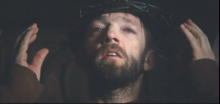
Once you had it in your mind that Moll was delivering a weirdly polite variation on Lewis, it was possible to appreciate the finer points even if you couldn't embrace them. The plot is pretty much stuck to, with the introduction of a mysterious young man called Valerio who sports a mask which covers his entire head, supposedly because he was horrifically burned in a house fire. But once he has been admitted to the monastery, he gets to know Ambrosio better and it becomes clear he's one of those fans of his, healing his migraine to endear himself to Ambrosio, and then, at a crucial moment, removing his motorcycle helmet to reveal he is a beautiful woman (Déborah François)! Er, removing his mask, I mean.
In the book this is Matilda, but she isn't otherwise named in the movie, so we have to see her as an agent of Satan sent to test the monk, which she does by curing him of a poisonous centipede bite and while he's delirious, mounting him and doing what comes naturally. This took away some of Ambrosio's participation in his personal road to Hell, blaming it on the impostor instead, which lets him off the hook to an extent, as does his final act of redemption which naturally comes too late for his soul, but does something to soothe the chaos he has left behind. The other main character here was pure of heart teenager Antonia (Joséphine Japy), who in apparently unrelated subplot is hoping to be married to decent nobleman Lorenzo (Frédéric Noaille), though later on the increasingly corrupted Ambrosio is attracted to her innocence and we can see where this is heading - including the big twists. If you can imagine a realisation of a deeply controversial novel which did its best to leave out the controversy, you'd have some idea of what this was like. Music by Alberto Iglesias.
So the Jean-Claude Van Damme movie wasn't based on Matthew Lewis' novel, then? In all seriousness, I've seen the other two film adaptations and overall suspect this is something that works better on the printed page. Odd really because it has cinematic potential. Maybe Ken Russell should have had a go. Frankly, I'm surprised he didn't.




 Display comments