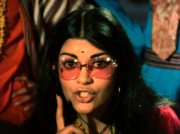
Currently the hippy movement in Western society has exploited the Eastern mysticism, and not everyone from Central Asia is sympathetic to what has happened to their culture there. One example of how those beliefs have been used as an excuse for sheer hedonism is in the person of Janice (Zeenat Aman), who spends her days with the dropouts, getting high and dancing - but where did she come from? Surely her life was not always like this? We have to go back to the roots of her problems, and that was when she was a child as the daughter of a rich businessman in Montreal...
We know it's Montreal during this flashback due to the fake snow drifting down outside, but don't get too comfortable in these studio-based surroundings because for the bulk of this movie the story took place in Kathmandu, and not on sets, but in the actual location, offering a rare look at the territory in the early seventies for Western viewers. But more importantly for Indian viewers of the day, it introduced Zeenat Aman to the world's cinema screens, and she was a sensation as she played a character far removed from what her native land's moviegoers were used to from their leading ladies.
The brainchild of star-turned-director Dev Anand, it wasn't quite enlightened enough to offer its heroine a non-tragic redemption at the finale, but the fact that it depicted an Indian woman who was prepared to open her mind to experiences outside the norm of the era was a step in the right direction, and Aman capitalised on her singular new persona for the next decade as she continued to headline controversial movies. That didn't quite negate the "have its cake and eat it" tone of this film, however, as it revelled in Janice's far out lifestyle while still managing to illustrate how she was on the road to ruin having turned her back on her family.
Janice wasn't always Janice, you see, and she has an older brother played by Anand, a much older brother who appears to be ageing at a rate far faster than she is, as the flashbacks show them about a year or two apart, but in the present brother Prashant is quite plainly now in his forties while Janice remains a youthful twentysomething. Prashant flies into Nepal with the express wish of getting his sister, or Jasbir as he knew her, back in the family fold, having reunited his estranged parents and now promising that he has found their daughter (over a long distance telephone call that requires them to yell down the receiver at each other to be heard - how far technology has come).
Being a Bollywood movie this was a musical as well as a drama, so there were interludes for R.D. Burman songs including a very welcome tune that married their usual stylings with a more Westernised hippy rock-pop approach that should appeal depending on your taste. Romance, you may have thought, would be difficult when the main plotline involved Janice denying her brother's existence, but Prashant did get a female admirer in Shanti (Mumtaz), who takes a shine to him yet is fairly obviously a token presence - it's no wonder that audiences were more captivated by the glasses-sporting Zeenat, as hers is by far the most interesting character. Not least down to her bad behaviour, which oddly doesn't render her a bad person here even if she does puff away on the bong and worse, reject her origins, as we see it was her parents' fault for bringing her up poorly that caused her to rebel. In its Indian view of the counterculture, on the other hand, there was a disdain, though that wasn't as bad as say, a villainous landlord, yet amusement can be gained from hearing the hippies regularly slammed as "idiots!".
As an Asian, I have always found our culture's prevalent attitude towards hippiedom and liberalism in general to be confounding and problematic. This film encapsulates that in a nutshell. Worth it for bringing Zeenat Aman to a grateful audience. Her finest hour was probably Don.




 Display comments