Stefan (Klaus Grünberg) is a German student hitchhiking to Paris, although as a truck driver who picks him up observes, he doesn't quite look the type. But he does get to the French capital, and there finds his funds running low, as he pays for a drink in a cafe but doesn't have enough to cover the bill; the man in charge, Charlie (Michel Chanderli), forgives him and even slips the cash back in his pocket as he leaves. But Stefan finds out and returns to argue with him, then the two quickly become friends as Charlie takes him under his wing. Yet Stefan is about to meet someone else...
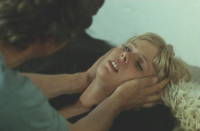
That someone else being Estelle, played by Mimsy Farmer in the role that won her a continuing cult status throughout the rest of her acting career. She had already appeared in middling profile parts, but More was the movie that captured the attention of those who responded to her elfin looks and the streak of decadence that she embodied here. Not to mention the fact that she spent a lot of this story separated from her clothes, always a surefire attention grabber. But this was no idyllic wallow in the hippy dream of 1969, as the times they were a-changin' and producer turned director Barbet Schroeder was more interested in the dark side of that bliss.
Basically this said that the reason the hippies were so peace loving and spacey was exactly the reason you'd expect nowadays: they were high for most of the time. In the time honoured role of the square who gets corrupted by the free and easy lifestyle, Stefan starts out wanting a more liberated existence only to end up chained to the needle, for it was not the likes of marijuana and LSD that ensnared him, but a drug that was going to make major influences on the following decade, and that was heroin. It might seem strange to see a film from the late sixties that took that as its narcotic of choice, yet it was evidence of how forward looking Schroeder was.
Not that what he was looking forward to was anything but a bleak future, assuming you had any future at all on heroin, or horse as as Estelle terms it. Stefan meets her at a party in Paris and is immediately entranced, this in spite of Charlie's warnings, and soon has made a date to meet with her again though his friend has just raided her purse - petty crime is merely part of the landscape for this lot. Once they have graduated to breaking and entering, Stefan has the cash to pay Estelle back with interest, and it is at her apartment that she offers him a joint, as if this were some awful warning drugs public information film where one high leads to another, far more damaging one.
Although on the surface Schroeder was being observational, there was a definite tut-tutting to the way things played out, much like every other film that took addiction as its subject, so if you're expecting a precipitous comedown for Stefan not only the second Estelle injects him with heroin, but the second she rolls him that joint a few days before, then there is very little to surprise you about More. The couple end up on Ibiza, before it was the island of choice for the world's clubbers, and here it's as if they're the only people in the world for much of the time, as there is very little contact between them and the outside world. There are a few other characters, including an ageing Nazi in exile (Heinz Engelmann) who they end up stealing from, but mainly this is about Stefan and Estelle fooling themselves that they're really living when they're actually doing the opposite. With occasional music by Pink Floyd, this was an oddly dingy example of the drugs movie considering its attractive location.




 Display comments