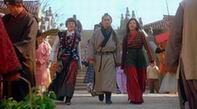
During the Ming Dynasty in China the Emperor (Chen Chang) and the Princess (Faye Wong) were forever trying to escape the palace to have their own adventures away from the watchful eye of their stern mother, the Dowager Empress (Rebecca Pan), yet every time they would be brought back by the guards, for their own protection of course. But the siblings' restless dissatisfaction was not to be confounded and while the Emperor was being caught for the umpteenth time, his sister managed to get away: some say she used magical martial arts, but others say she simply strolled out of the door while the guards were busy with her brother...
With a title like Chinese Odyssey 2002, you might be expecting an Oriental sequel to 2001: A Space Odyssey, but what you're actually offered is a romantic spoof on those far more sincere Hong Kong movies where true love and tragedy are bedfellows. Not that writer and director Jeff Lau did not have the utmost faith in the power of love and how it could transform his characters, it's just that for the greater part of the running time the subject was treated with zany irreverence. This was not quite on the Stephen Chow level of humour as there were far less action sequences and the special effects were limited to the odd gag or two, and it did not have the lush, glossy look of the contemporaries it was sending up.
What it did have was a truly endearing sense of humour and a winning way with emotion; you're not likely to be wiping away many tears when it turns serious, but you're excused if your eyes mist up a little. Although there are in-jokes, a number connected with the directorial works of producer Wong Kar-Wai, you don't need an encyclopaedic knowledge of the references to appreciate this, as the jokes are successful on their own terms, no matter what the parody targets might be. As for the plot they adorn, it's a simple, even traditional tale of mistaken identity and gender reversal that sees the Princess turn up in the South as a traveller, and get embroiled with the lives of another brother and sister.
Embroiled because these other siblings both fall for the Princess, without really understanding why. The brother is Li Yilong (Tony Leung Chiu Wai), a restaurant owner known as a bully round his way, and the sister is Phoenix (Vicki Zhao, like Wong a successful pop singer in the East), who to add to the confusion dresses like a man and has not cottoned on to why the opposite sex rejects her. For even more bewilderment, the Princess is disguised in men's clothes to avoid being recaptured and even though Faye Wong makes a less than convincing male Phoenix falls for her and Li Yilong is not entirely sure how to take his affection for this newcomer. This could head off in any number of dodgy directions, but Lau keeps things light and curiously innocent.
Not forgetting funny, as there are plenty of laugh out loud moments of silliness, as when The Princess announces her intention to leave the restaurant and travel on, which leads to Li Yilong embracing her in a manly goodbye for about a month, in various locations because he cannot admit to himself he doesn't want to be parted from him. Her. Anyway, while there are all those cheerfully absurd bits, they can transform into scenes that are unexpectedly touching as when Li Yilong and the Princess land up to their necks in the mud, an item of daftness that turns very sweet when he starts looking after her, getting her water by ingenious means, and admitting when they are rescued that he was really enjoying himself. The whole gay aspect never gets too heavy, alluded to in gently mocking fashion, so if finally the tone grows a shade too maudlin compared with the preceding goodnatured nonsense, it is likely to have the viewer feeling warm and cosy by the end. Music by Frankie Chan and Roel A. Garcia.
Some background on Jeff Lau, one of my favourite Hong Kong directors. He started out as a graphic designer but turned to acting and scriptwriting, before launching his directing career with the Haunted Cop Shop movies, lacklustre knockoffs of the Mr. Vampire series that were co-written with his regular partner Wong Kar Wai. They still write together on occasion, penning classics like Saviour of the Soul and God of Gamblers 3, and formed their own production company.
Lau gave Stephen Chow his first hit comedy All For the Winner which led to a string of successful collaborations. Later on Lau directed second-unit on Kung Fu Hustle. He's made straight dramas but those and A Chinese Odyssey 2002 are among his few films that don't feature some form of gravity defying kung fu or outrageous special effect.
Chinese critics recognise Lau's films have a unique flavour owing to his knowledge of classical literature, pop culture in-jokes and love of Shakespearean wordplay. His movies: '92 Legendary Rose Noire (1992) and A Chinese Odyssey (1995) are rated among the greatest Chinese films of all time. A Lau movie typically starts like a zany Zucker brothers spoof then turns progressively serious, romantic and philosophical. Oh, and lovely Athena Chu's casting as a boy is a reference to the first Chinese Odyssey.




 Display comments