Leo von Harden (John Gilbert) and Ulrich von Eltz (Lars Hanson) have been best friends since childhood, and remain so while doing their military service. This morning, the soldiers are awakened and told to assemble on the parade ground, but when Ulrich goes to rouse Leo, he isn't in his bed - he's been out all night and not returned. At the parade ground, Ulrich tells the commanding officer that Leo hasn't been feeling well hence his non-appearance, and they both go the barracks to see him. Ulrich's worries are allayed when Leo is indeed still in bed - he's sneaked in while the others were outside, and when the officer leaves, they dance a victory jig - which is then noticed by the officer. So they are sent to clean out the stables as punishment, but they don't care because they will soon be heading home on leave; it's at the railway station, however, that Leo catches sight of a woman who leaves him entranced: Felicitas (Greta Garbo). He must get to know her better...
This was the first film that Garbo and Gilbert starred in together, and its success was just as much down to the blossoming offscreen love affair as it was to do with the melodrama occurring onscreen. The novelty of seeing two movie stars fall for each other as they made their film was simply too much to resist for the general public, and assured Garbo's place as a world famous icon. Watching it today, the film is as cheesy as a block of years-old Stilton, but no less enjoyable for that as it works equally well as high camp as it does a serious romance. It's all about the vamp, who we at first are not aware is a vamp, putting herself between the two old pals, and leaving a trail of ruined relationships in her wake.
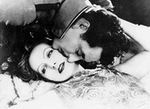
Flesh and the Devil (a deliberately saucy title) was based on Hermann Sudermann's 19th Century novel The Undying Past, adapted chiefly by Benjamin Glazer. Garbo hardly appears for the first half hour, most of which is taken up with establishing what a great bond there is between Leo and Ulrich (we even see they are blood brothers). Ulrich has a sister, Hertha (Barbara Kent), who is in love with the older Leo, but he isn't interested, no, not because he's in love with Ulrich, but because he still sees her as the kid sister of his companion. At the first ball of the social season, Leo gets to finally introduce himself to Felicitas properly, and before you can say "whirlwind romance" they are acquainting themselves to an amorous degree in the garden. Next scene, they're lying in Felicitas' boudoir and have obviously been at it like rabbits - this film was extensively cut by British censors for its passionate embraces, so be warned.
Anyway, while they're enjoying each other's company who should walk in but, oh dear, Felicitas' husband, the Count (Marc McDermott)? And so he challenges Leo to a duel, telling everyone that they have had a dispute over cards to save face, and of course Leo wins. Now a widow, Felicitas promises to wait for her lover while he is punished by the military with service in Africa for five years. Ulrich manages to get that cut down to three, but when Leo returns there's a nasty surprise waiting for him. While you can see there's a definite screen chemistry between the two stars, Felicitas is actually revealed to be a mediocre woman unworthy of such devotion, and Leo and Ulrich's manly affections are seen to be far more pure. Yes, it's all undeniably gay, with Gilbert embracing Hanson almost as much as he embraces Garbo, with the two actors' noses just about touching every time. Never mind their noses, their lips are just about touching too. So maybe Flesh and the Devil is a paean to manlove rather than the swooningly heterosexual work it's usually trumpeted as? Maybe.
One of the key Garbo performances. She shows the audience Felicitas is shallow and selfish, but conveys the fascination her beauty exerts over Leo at the same time, an amazing achievement for a 21-year-old. The scene in church, where Garbo turns the Communion cup to drink from the place her lover's lips have just touched is powerful and erotic.




 Display comments