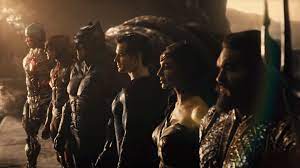
As the world mourns the death of Superman (Henry Cavill), a guilt-ridden Bruce Wayne (Ben Affleck) teams with Wonder Woman (Gal Gadot) to assemble a team of heroic meta-humans in order to fight off Steppenwolf (voiced by Ciarán Hinds) and his invasion force from the dark alien realm of Apokolips.
Whereas back in the day troubled studio productions like Marilyn Monroe's final vehicle Something's Gotta Give (1962) were hastily shelved never to see the projector's light, today fan power seemingly has much more sway. Hence this four hour long restoration of Zack Snyder's original cut of Justice League exists solely because fans of Snyder's "dark" and "gritty" take on the DC pantheon demanded it; liberated from the alterations wrought by now personae non grata Joss Whedon and writer-producer/then-DC maven Geoff Johns at the behest of Warner Brothers. Most media outlets seem to be pitching this as a triumph of art over commerce, but the reality is more complex than that. Almost the inverse of the furore over Star Wars: The Last Jedi (2017), but with similarly unsettling implications, the "Snyder Cut" somehow became more than just a movie. More by accident than design the film came to encapsulate a very specific socio-political movement in pop culture. Rightly or wrongly Snyder's "uncompromised" vision, with its gloomy tone, graphic violence and sporadic profanities (you get to hear Batman and Cyborg drop f-bombs, oooh!) has been embraced as a cinematic head-butt to the "sanitized", "kiddie-fied", corporate controlled antics over at Marvel. By comparison fans perceive the Snyder Cut as the unapologetically dark and brooding vision of a true auteur filmmaker and its eventual release as justification for all the toxicity unleashed upon all the dissenting voices that stood in their way. All of which conveniently overlooks how "dark" and "edgy" are also commodities corporations can flog on the marketplace. And that, where there is money to be made, Hollywood studios will happily dish out multiple versions of one movie. See how many Blade Runner (1982) cuts are out there?
So, divorced of all socio-political posturing and culture wars, how does the Snyder Cut stack up as y'know, an actual movie? Or should that be streaming mini-series since Snyder has broken the film into chapters and, curiously given its visual ambitions, a counterproductive 4:3 aspect ratio? Well, it is undeniably more cohesive than the Frankenstein monster Whedon and Johns stitched together back in 2017. The plot makes more sense and provides solid motivation for Steppenwolf, leaving him far less generic a villain and finally gives fans a glimpse of the DCU's legendary arch-nemesis Darkseid (voiced, as in his animated outings by Ray Porter). An expanded runtime also enables Snyder to indulge in elaborate flashbacks and back-story. He fills in more details about the dense mythology of the DCU, indulges in a bewildering array of alternate timelines and possible futures and crams in surprise cameos from notable DC characters likely to delight hardcore fans. However, even with all the extra time the narrative remains an unwieldy, multi-tentacled leviathan lurching in all directions as it struggles to relay vast stretches of narrative and visual information. Even leaving aside the sprawling Tolkien by way of Jack Kirby-like cosmic quest for the mystical whatsit that serves as the hub of the narrative, there is a lot going on. Including a fairly potent rumination on tensions between fathers and sons and a portrait of how women show strength dealing with grief. The cast are for the most part solid. Gadot, Affleck and Mamoa remain affable focal points, Cavill is... also there (sans CG-face, mercifully), Ray Fisher benefits most from the restoration bringing pathos to Cyborg's Frankenstein-like plight. Only Ezra Miller's aggressively nerdy yoga instructor interpretation of The Flash continues to grate and bear scant resemblance to the character in print. As the so-called comic relief he also drops more lead balloons than the Luftwaffe. Supporting players J.K. Simmons as Commissioner Jim Gordon, Amy Adams as Lois Lane, Diane Lane as Martha Kent and Amber Heard as Mera (sporting a curious British accent a la Carrie Fisher in the first Star Wars (1977) that is weirdly absent in Aquaman (2018)) snag their share of memorable moments. Yet for all their combined efforts the story never truly gets its emotional hooks into the casual viewer. Similarly the third act climax, for all its sturm und drang, fails to give viewers any grasp of humanity's peril within all the crash-bang-wallop on display. A problem that did not beset Whedon's Avengers Assemble (2012) even though the films admittedly have very different agendas. This is a reoccurring problem with Snyder's teen goth rock video interpretation of DC's richer, more faceted comic books. That said taken as one-dimension superhero adventure the film delivers action and spectacle with aplomb. It climaxes with a brutal showdown between Steppenwolf and the League that one-ups its previous incarnation. However, Snyder being Snyder, the film does not know when to quit. He unwisely follows up the cathartic release of the third act with an apocalyptic coda that not only unnecessarily trots out DC's most grating character (inexplicably embraced worldwide as the poster child for self-entitled internet trolls) but ends on an unresolved plot thread left dangling all the way back in Batman v Superman: Dawn of Justice (2016). Unless fans start clamouring for more...
When Grant Morrison wanted to have Batman drop the F-bomb in his "mature readers" graphic novel Arkham Asylum, he was sternly told by DC "Batman doesn't swear!" So what changed from the 1990s to the 2020s?
Posted by:
Andrew Pragasam
Date:
23 Mar 2021
One imagines Zack Snyder's justification would be the same as to why Batman suddenly murders people left and right: "because it's edgy and cool and REAL, man." Now I'm wondering whether Battinson will swear as much as Batfleck?




 Display comments