Sakon Shiba (Tetsuro Tanba) is a wandering samurai for hire, traveling across Japan to pick up work as a swordsman wherever he finds it. However, he won't just take any job, as seen when he is walking through the countryside and notices an ornamental hairpin on the ground, which he lifts to have a closer look at. Just as this happens, a peasant scrabbles out of the bushes and runs away, and intrigued, Shiba spots a shack nearby so heads over to investigate. Inside he is met with a startling scene: a young woman, obviously with some money in her family, has been tied up and bound to the supporting pole, and as she gets the gag out of her mouth she has one demand: "Kill me!"
She's not the only person in the shack, for there are also three peasants who are her kidnappers, and the desperation on their faces informs the rest of the story, for this was a tale of a community in a bad way driven to hazardous means to even the odds. Specifically, kidnapping Aya (Miyuki Kuwano), the daughter of the chief magistrate in the area, whose draconian taxes have led to widespread poverty, and there's no real sign that he will relent and give the peasants the relief they need. Now, Shiba could go either way with this, he could subdue the peasants and take the girl back, or he could side with them and assist their struggle. His decision comes after some rumination.
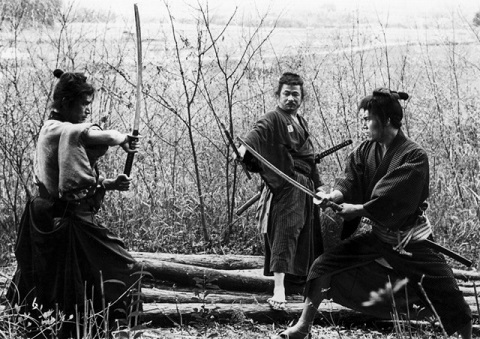
It also guides the path of the outcome of the aforementioned struggle, and it might not surprise you, him being the hero and all, that Shiba opts to help out the kidnappers, his conscience having been pricked by their plight. Thus we have our first outlaw samurai of the title in what would be the debut movie by director Hideo Gosha, who would quickly become an action expert and much respected by those who kept a close watch on the Japanese genre movie scene; this started as he meant to go on, with involved plotting and often brutal action sequences, here characterised by the callousness the participants went about the unlovely business of dealing in violent death and destruction.
Meanwhile, back at that plot, we meet our second outlaw samurai when Kyojuro Sakura (Isamu Nagato), who has been hired by the magistrate, switches sides as he is faced with the reality of the evil he is supporting by his willingness to be recruited by the victimising authority. The third was Einosuke Kyoko (Mikijiro Hira) an aloof chap who for almost the entire film seems to be on nobody's side but his own, until the raging injustice of the situation wins him over to Shinba's point of view and he decides to help him: the power of a nagging conscience telling you that you could be taking a far more moral course is central to the drama. But that morality, a choice that must be consciously made, also has it that you will have to pay a price for your would-be nobility in making that decision.
Throughout Gosha used simple ideas to underline the stark difference between the haves and have nots in this society: the haves enjoy the luxury of behaving as they would like, while the have nots must get by with the limited cards they have been dealt until they cannot take this anymore. Food was an effective signifier for this, as the peasants exist on porridge of millet or potatoes because they have no other option, and when they set aside a bowl for the disdainful Aya, she turns her nose up at it because she is far more used to the finer things in life. Similarly, we doubt Kyoko's commitment will be virtuous because he makes a point of dining on only the best food and wine can find, while Shiba and Sakura are content to share the food of the disadvantaged. But this was as much a martial arts flick as it was a social injustice lesson, and that activity was put across with efficiency, yet also a scrappy quality to render it more realistic. More of a cult movie for samurai fans, this would impress the seasoned viewer of the genre. Music by Toshiaki Tsushima.
[The Criterion Collection release this on Blu-ray with these features:
High-definition digital restoration, with uncompressed monaural soundtrack on the Blu-ray edition
Trailer
New English subtitle translation
PLUS: A booklet featuring a new essay by film critic Bilge Ebiri,]
Shaw Brothers remade Three Outlaw Samurai as the Jimmy Wang Yu vehicle The Magnificent Trio. Hideo Gosha had a fascinatingly unorthodox career. Starting with crowd-pleasing chambara romps in the Sixties he moved onto darkly satirical crime dramas in the Seventies. Then in the Eighties unexpectedly churned out a string of feminist dramas scrutinizing the role of women throughout Japanese history.




 Display comments