In the year 2048 giant monsters or 'kaiju', including the most terrifying of them all the unstoppable Godzilla, wreaked havoc around the world. Hounded to near-extinction, the last remnants of human life took to the stars as part of a wandering space armada governed by benevolent humanoid aliens called the Exif. One such evacuee was young Haruo Sakaki (voiced by Mamoru Miyano) who lost his parents to Godzilla. Now an embittered hot-shot military hero thirsting for revenge, Haruo joins an expeditionary force determined to reclaim their planet from the radioactive beast.
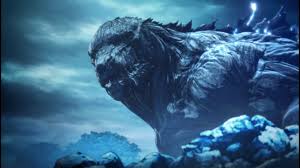
On the heels of anime auteur Hideaki Anno's divisive live-action Shin Godzilla (2016), Big G made his anime debut with Godzilla: Planet of the Monsters. Given the limitless possibilities of the medium it is a wonder nobody thought to do this before. Unless you count the parody Gudzilla (1967, remade in 1987) or the fondly remembered Hanna-Barbera show. Written and co-directed by Gen Urobuchi, screenwriter behind mind-bending magical girl anime Puella Magi Madoka Magica (2011), it is a stunningly designed production part-funded by Netflix. Although released online as part of their streaming service, Planet of Monsters played theatres in Japan where it performed respectably. Which bodes well given it is the first in a forthcoming trilogy with part two due soon. Lavishly animated by Polygon Pictures, the studio behind Mamoru Oshii's most recent works Ghost in the Shell: Innocence (2004) and, God help us, The Sky Crawlers (2008), the film presents viewers with a sparingly used photo-realistic Godzilla. Design wise this version is midway between Gareth Edwards' bulky redesign in Godzilla (2014) and the death-masked terror Anno presented in Shin Godzilla. Wholly devoid of personality but an imposing threat. Mixing grounded 2D human characters with tactile 3D mecha and monsters, the animation has a subdued, even somber tone reflecting the dour, brooding nature of the film itself. Planet of Monsters weaves a story skewed towards a particular kind of Godzilla fan.
Since the end of the Showa era Godzilla series (1954-1975) filmmakers have been unable to decide exactly what Godzilla is supposed to be. His parent studio Toho Films has been torn between catering to one camp that want Godzilla as a remorseless killing machine and children, along with fans like myself, enamoured with the idea of a franchise where the monster is the hero and has a personality. Lately devotees of the heroic Godzilla have had to contend with the spurious assertion their concept is rooted in a racist desire to whitewash the events of Hiroshima and Nagasaki but that is a debate for another time. For better or worse, Planet of Monsters delivers the grim, apocalyptic story many 'serious' Godzilla fans always wanted. And the rest of us can lump it.
Which would be fine were the characters not so uniformly colourless and dull. Relegating Godzilla to the background for the bulk of screen-time (a decision understandable in a costly live-action film, less forgivable in animation), the plot focuses on yet another group of grim-faced, gung-ho military types. Only without the goofy charm of say Masaaki Tezuka's similarly militaristic Godzilla x Megaguirus (2000) and Godzilla x Mechagodzilla (2002). Haruo's defining character trait is his savage burning hatred of Godzilla. We spend a great deal of time watching Haruo rage over Godzilla, recklessly endanger his team in pursuit of revenge or repeatedly scream "I'll get you, you bastard!" prior to yet another kamikaze attack. Haruo's sour attitude infects the film as a whole as it settles into a permanent foul mood, sidelining several of the more interesting supporting characters and tantalizing threads hinted at in Urobuchi's script. Notably the Exif's claim that other Godzilla-like agents of destruction exist on other planets. In a radical shift from the traditional concept of Godzilla as the embodiment of nature avenging itself against human pollution, here characters state unequivocally that the Earth belongs to mankind. Haruo maintains Godzilla is the interloper that not only robbed humanity of their planet but dignity and pride. Which coupled with insistent rallying cries about the nobility of youth sacrificing themselves for a noble cause adds a faintly unsettling undertone. On the flip-side aspects of Planet of Monsters undeniably echo the original Godzilla (1954). Opening with a poignant scene where a group of elderly folk abandon the Exif mothership to lessen the burden on the young, the first act presents a harrowing vision of humanity's aftermath. Mired in starvation, desperation and the slow erosion of human decency. It is talky as heck but intermittently powerful. Eventually the action-packed third act delivers some belated excitement, despite failing to involve us in the fate of the human characters while trying to have things both ways: intermingling triumph with nightmare. However, the post-credits scene implies an intriguing new twist that will hopefully lead part two in a more promising direction.
This was more like Godzilla: Talking Book Edition until the last half hour. When Big G arrived, or did he, he resembled Tor Johnson for some reason. I see they've kept the disgust-o-vision design from Shin Godzilla. It's OK, but I miss whimsy.
Posted by:
Andrew Pragasam
Date:
30 Mar 2018
Amen, brother, amen. I believe with all my heart there is a great movie to be made centred around a heroic Godzilla with a personality. They just need the right dramatic take, playing for sincere emotion and pathos rather than the camp so many 'serious' genre fans despise.
Posted by:
Graeme Clark
Date:
1 Apr 2018
Oh, I quite liked the camp. But I guess the days of Godzilla performing a Highland Fling after a particularly successful beatdown are over...
Posted by:
Andrew Pragasam
Date:
2 Apr 2018
I liked the camp too! But it is despised by a vocal contingent of Godzilla fans, some of whom went on to produce their own versions. So we get things like this, Shin Godzilla and Alex Cox's irksome Godzilla comic book where Big G happily stomps a family of American tourists to death. I'd rather see a 'serious' treatment that preserves the whimsy and eccentricity inherent in the mythos.
Oh, and Godzilla's pogo dance in Godzilla vs. Monster Zero was effects director Eiji Tsuburaya's tribute to a manga character called Ahso Matsu-kun. The studio released press photos with the entire cast performing the dance including Nick Adams!




 Display comments