Seeing Alfred Hitchcock's romantic thriller Vertigo at an early age was a formative experience for Brian De Palma, and would go on to feed into his work as a film director as everything that someone in that profession has to do with regard not merely to crafting memorable visuals but also how they treat the characters and the audience's response to them is all there in every frame of that movie. But De Palma did not start out thinking he would become a filmmaker, he planned to go into science for that technical side of things was more fascinating to him as a youngster. He was the son of a surgeon, and got the chance to sit on the operations his father carried out, which would naturally make observers think about how he used blood and gore in his thrillers...
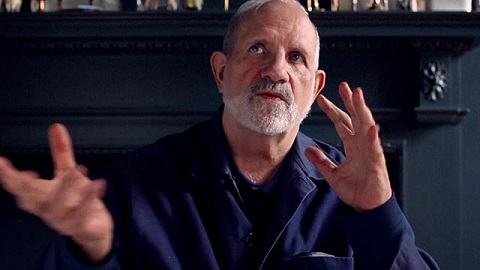
For that was what he became most celebrated for, and indeed reviled for, perhaps the highest profile of the directors who used violence in their work for effect, and therefore one of the most criticised. As if aware of De Palma's reputation as a screen misogynist, if not one in real life, the creators of this documentary sought to mark out precisely how his mind went and prove there was a lot more depth to his choices than some simple shoot 'em up (or even slash 'em up) purveyor of schlock. To do so, they sat their subject down, pointed a camera at him, and got him to reminisce and explain over the course of a week, footage they whittled down to just under two hours of documentary.
This can be a tricky proposition, as not every artist is capable or willing for that matter to discuss their motivations and choices, and if De Palma had been coy or worse, boring, then Noah Baumbach and Jake Paltrow would have had little to work with. How lucky they were, and how lucky anyone who saw this was, that he was an intelligent and engaging dissector of his canon, rolling out the anecdotes (and there some excellent ones) and honest enough to admit the times where things went wrong as much as he was pleased to note when things had gone right. Derivative was a word that was often used in association with this efforts, thanks to his magpie tendencies to pick up inspiration from his influences, but here you came to understand why.
His Hitchcock homages, for instance, were justified by dint of all those techniques the Master of Suspense invented were there to be built upon rather than allowed to pass into the past, they were too good to allow to slip away, and the same went for all those other films, classic and cult alike, therefore watching a De Palma could be regarded as watching a whole history lesson in what was great about using film to tell a story. This was down to so much of what had established cinema as a popular artform able to be discerned in his productions, and time and again his technical prowess was depicted as saving a movie that in others' hands could have simply been uninspired, even hack work. Watching this and you came to realise that everyone is the sum of the parts of their experience, and their personalities were assembled from whatever they had admired or been negatively affected by.
The structure was simple: beginning from De Palma's early years, we moved to film school where he threw himself into the craft alongside a bunch of other talent who would define the nineteen-seventies in Hollywood, a group of which he would come to be regarded as the bad boy thanks to his interest in the darker side of life, or cinema, as you never forgot you were watching a movie when his particular style was so important to relating the story. We breezed through the early counterculture comedies, to his breakthrough with Stephen King adaptation Carrie, and the blockbusters of the eighties and nineties which alternated with more personal thrillers, to the point with Mission to Mars where he was disenchanted with Hollywood and moved to more independent means to make his movies (his output sadly slowed in this latter period presumably because he was not getting the big cheques written for him by the major studios). There was a sense this was made for the fans, and anyone who might be intrigued but not so knowledgeable about his canon would be welcome, but this was really for those who appreciated De Palma - his detractors would not be won over. If you did appreciate him, this would be utterly absorbing.




 Display comments