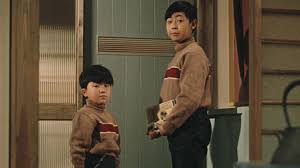
In a quiet Tokyo suburb youngsters Minoru (Shitara Koji) and Isamu (Masahiko Shimazu) Hayashi like to watch television at their neighbor's house. This displeases Mrs. Hayashi (Kuniko Miyake) who, like most women in the neighborhood, contends the TV-owning couple set an unwholesome example. For her part Mrs. Hayashi winds up a target of suspicion when busybody Mrs. Haraguchi (Haruko Sugimura) claims she has not paid her monthly dues for the local women's club. When Minoru and Isamu ask their parents to buy a TV set, Mrs. Hayashi refuses. Partly for fear of further fuelling the gossips' mistaken belief she is flush with cash. Her refusal prompts a tantrum from the boys whereupon Mr. Hayashi (Chishu Ryu) demands they be silent. So Minoru and Isamu decide that is exactly what they will do. As a protest they refuse to speak a word until their parents buy a television set.
To this day Yasujirô Ozu remains feted by critics around the world for his minimalistic, socially observant slice of life dramas. Among them the profoundly moving Tokyo Story (1953) which also co-stars actors Chishu Ryu and Haruko Sugimura. Yet Ozu did not restrict himself to solemn dramas. In fact he began his career directing a number of silent comedies including the children-centred I Was Born, But... (1931) of which Good Morning is a loose remake. Of course Ozu being Ozu this return to comedy is a wry social satire rather than a gut-busting giggle-fest although the great director did add something new to his arsenal: fart jokes. Not the sort of thing Ozu's art-house admirers in the West might expect from the maker of low-key, humanist fare. But yes, the child heroes of Good Morning are obsessed with perfecting their poots. To do that Minoru and Isamu take to consuming small quantities of powdered Pumice stone. In fact one reoccurring gag concerns Mrs. Haraguchi's son whose attempts to match the boys' bottom-burping prowess end with him soiling himself.
Gags about gaseous emissions aside Good Morning deals primarily with social etiquette and its continuing importance in Japanese society as well as the clash between pre and post-war values. Is the film an indictment of rigid conservatism among 'traditional' Japanese or the western consumerist infected sense of entitlement among the post-war generation? Probably a little of both. Ozu neither criticizes the elders nor Minoru and Isamu but highlights the divide between parents concerned with job security and saving for old age and kids happy to splurge on a consumer item almost all of the older folks consider useless. Mr. Hayashi worries television will reduce Japan to a nation of 'idiots' to which his drinking buddies agree that it is "a bad idea to have too much convenience in life." However, Mrs. Hayashi's reasons for spurning the TV set have more to do with her standing among her gossipy neighbors. Propriety is everything among these middle-class suburbs and Ozu cannily highlights how the Japanese will tie themselves in knots to avoid being shamed in front of their peers. Good Morning deftly illustrates how a seemingly small gesture like children refusing to talk can have a big impact on a close-knit community. Specifically, Minoru and Isamu refuse to indulge in the traditional Japanese tenet of politeness. Baffled by the boys' silence, neighbors mistakenly believe it has something to do with themselves. Poor old Mrs. Hayashi bears the brunt of their ensuing misunderstanding, paranoia and passive-aggressive hostility. By simply refusing to talk, the children become a genuinely disruptive influence and almost unravel their delicate community.
The film's message is deeply Japanese. One need not necessarily like one's neighbors but you cannot function without them, so it is best to be polite. However, whether by accident or design, there are a few cracks in its altruistic outlook. Everyone in the neighborhood seems to have a low opinion of the westernized couple that share their television set with the local kids, even though they seem perfectly nice people. Even Minoru and Isamu's schoolteacher (Keiji Sada) makes a point of giving the westernized woman the cold shoulder while slowly falling for the boys Aunt Setsuko (Yoshiko Kuga), a model of dutiful, polite Japanese virtue. True to form Ozu proves more interested in exploring the way people interact by crisscrossing subplots and strays from the central conceit in a way few comedies would. One could argue the core issues remained unresolved come the fadeout and no-one really learns a lesson. Yet Good Morning remains an insightful look at the social dilemmas amidst immediate post-war Japan and the performances, particularly by young actors Shitara Koji and Masahiko Shimazu, remain delightfully natural.
Was this the first sighting (or hearing) in cinema of the much-maligned fart joke, or does it have an earlier provenance?
Posted by:
Andrew Pragasam
Date:
16 Jan 2017
It may well be. Some cite 1971's Cold Turkey as pioneering flatulence humour in movies long before the famous bean-eating scene in Blazing Saddles. But I am sure there must be some silent movie out there that did the gag first. Silent but deadly as they say.




 Display comments