| |
Gojira is that most Japanese of monsters, not merely because he is gigantic, but because he represents something essential in their twentieth century culture: the ending of the Second World War when two atomic bombs were dropped on their nation to stop the fighting. That combined devastation and threat - cease all combat or else we will do this again - was such a potent event in their country's psyche that it fuelled the premise behind the 1954 debut of the character, a menace brought about and standing in for nuclear devastation. Considering it was the United States that started all this off, you would think Hollywood had some cheek in appropriating it.
In 1954, Gojira was renamed Godzilla and new scenes were shot and inserted, starring Raymond Burr who reacted to various things that were part of the original: the result was a huge hit, but also one that cemented these films in the minds of the Western audiences as essentially kids' stuff, the serious intent staying very much on the other side of the Pacific. And to be fair, the longer the Japanese series went on, the more juvenile it became as its studio Toho twigged that children were probably the biggest audience for these efforts; during this period as the first run came to an end, Toho licensed the brand to American cartoon studio Hanna-Barbera.
This resulted in a well-recalled toon for television, largely because of its earworm theme tune, but again: kids' stuff. When in 1998 the Independence Day team of Roland Emmerich and Dean Devlin followed that hit up with a remake/reimagining, simply titled Godzilla and boasting the tagline "Size Does Matter", a blockbuster was promised, but never arrived as the film flopped, with terrible reviews and audience indifference, despite it being far more entertaining than anything this duo produced, before or since. But the potential viewing millions thought it juvenile, and the diehard fans were insulted by the concept of an American creation of a Japanese source.
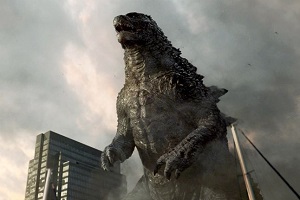 Therefore when a reboot was suggested for the sixtieth anniversary, there was more scepticism, yet in 2014 director Gareth Edwards, who had already crafted a low budget, off-kilter Godzilla homage with the arty Monsters, managed to secure the gig, and as a consequence, was rewarded with one of the biggest hits of the year. Gone was any hint of a campy tone, here the atmosphere was laden with dread as his chief influence was Jaws, indeed it was a very Steven Spielberg affected production all round, from its scale to its insistence on having the spectacle of Godzilla's return seen through the eyes of children, who after all see the world as too big for them as a matter of course. Therefore when a reboot was suggested for the sixtieth anniversary, there was more scepticism, yet in 2014 director Gareth Edwards, who had already crafted a low budget, off-kilter Godzilla homage with the arty Monsters, managed to secure the gig, and as a consequence, was rewarded with one of the biggest hits of the year. Gone was any hint of a campy tone, here the atmosphere was laden with dread as his chief influence was Jaws, indeed it was a very Steven Spielberg affected production all round, from its scale to its insistence on having the spectacle of Godzilla's return seen through the eyes of children, who after all see the world as too big for them as a matter of course.
This garnered far better reviews, as if its decision to play it completely straight generated respect from those who were suspicious of a giant monster flick containing even the tiniest hint of humour, yet looking back it made for a very dour experience, not helped by a muted colour palette and a focus on the military trying to overcome not only the big green guy, but a couple of other huge monstrosities trying to meet up to mate and spawn even more across the globe. As if consciously deciding not to offend that military who were so helpful to their project, this merely wound up with a bunch who were blandly professional, capable and utterly without personality.
Aaron Taylor-Johnson was our lead, about as colourless as it was possible to be in this sort of affair, and the rest of the cast were studded with performers who would not be carrying a blockbuster in 2014 had there not been the main draw of the massive reptile. But Godzilla was so stingily implemented, supposedly to sustain a mystery and suspense about him, that until the grand finale he was more or less a bit player in the movie that bore his name - meanwhile the overqualified likes of Juliette Binoche, Ken Watanabe, Bryan Cranston and Sally Hawkins stood about looking awed in his presence, as opposed to odd in his presence, which would have been an improvement.
Despite ringing the box office tills across the world, it was five years before the sequel, Godzilla: King of the Monsters showed up, and Edwards had been ditched. This time, the reviews were less glowing, and the box office tills rang less too, as it was clear this was a franchise after fellow monster King Kong had made a return a couple of years previously in Kong: Skull Island, a fair but not stunning reimagining of the start of the 1933 classic original as a Vietnam War movie. But with this new Godzilla arrival there were grumblings: what happened to the seriousness, that gravity? Was this not more or less the equivalent of a Transformers sequel in effect?
Between the two Godzilla pieces from Hollywood, there was a fresh, distinctively Japanese version called Shin Godzilla in 2016 which very much ploughed its own furrow as a reaction not to atomic weaponry, but to the Fukishima power plant disaster, painting the true villains as not so much giant monsters, more those in the boardrooms who allowed such calamities to occur. With a new, weirdly revolting incarnation of the creature, if it was not wholly artistically successful it did at least put a new spin on an old property, which was what the American incarnations were trying to do with their CGI world-building, only they were following a newer model: Marvel.
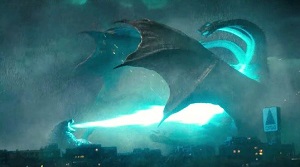 It appeared if you were truly going to enjoy Godzilla: King of the Monsters, you would have to do a lot of convenient forgetting about how clunky the bits in the spaces were: the human interest. Essentially, as before they were onto a loser trying to make anything but the giant beasts hitting each other interesting; casting girl of the moment Millie Bobby Brown as the protagonist might seem like something to bring the kids in, but giving her so little of value to perform was not going to attract anyone for long, and as you might have expected this entry faltered at the box office in comparison to the 2014 version, despite some improvements. It appeared if you were truly going to enjoy Godzilla: King of the Monsters, you would have to do a lot of convenient forgetting about how clunky the bits in the spaces were: the human interest. Essentially, as before they were onto a loser trying to make anything but the giant beasts hitting each other interesting; casting girl of the moment Millie Bobby Brown as the protagonist might seem like something to bring the kids in, but giving her so little of value to perform was not going to attract anyone for long, and as you might have expected this entry faltered at the box office in comparison to the 2014 version, despite some improvements.
Michael Dougherty was enlisted to replace Edwards in the director's chair, Edwards having gone mysteriously silent after his Star Wars spin-off Rogue One some years before, and did one thing right, anyway: he made the monsters the centre of the action. That did not excuse the sight of capable thespians like Charles Dance, Ziyi Zhang and Bradley Whitford getting stodgy dialogue to mouth, but they must have known what they were required to do, fill in the gaps that the budget could not pack with even more action. By this stage, a "silent" Godzilla movie with only the monsters interacting was looking like a better prospect.
Not that we would get that, though Godzilla, villainous, three-headed Ghidorah, healing butterfly Mothra and rogue element, dinosaur bird Rodan were demonstrably the stars in the 2019 movie, and despite further attempts to make this look "realistic" by adding pouring rainstorms and abundant night time sequences - who needs realism in a kaiju flick, honestly? - it was the battles that stood out. Nonetheless, old time Big G fans might miss the goofiness of the earlier, Japanese franchise when everything was so deadly serious that the element of fun was sorely lacking, not to mention the degree of mass destruction left this appearing like a CGI Book of Revelations that the human race could not reasonably recover from. Fair enough, we never saw Tokyo endlessly rebuilt in the classic series, but the appetite for destruction was way out of proportion, even for Godzilla. It was clear the Americans didn't quite get Gojira, not yet. |


