| |
Although the X Certificate for British cinema releases was instigated in 1951, it took two years for an actual British film to be awarded it, and the picture was none other than Cosh Boy, an adaptation of a "torn from the headlines" play. Those headlines had been decrying an increase in juvenile delinquency in the post-war climate, much as they had across the Pond in the United States, and the movies sought to capitalise on this worry by providing solutions to this issue - or, you know, cashing in on public fears by offering them a lightning rod to really get het up about. Over there, they had The Blackboard Jungle and Rebel Without a Cause.
Over here? Nothing so worthy of classic status, more cult success, as Cosh Boy went on to enjoy when it was occasionally broadcast on television to a bemused audience decades later. But back in 1953, it was a focal point for controversy, decried and despised as precisely the sort of film that would encourage teen violence and petty crime that would only escalate if the courts and police did not crack down on it with uncompromising force. According to this, the problem stemmed from a lack of father figures to guide the youngsters, which funnily enough is something twenty-first century thinking agrees with.
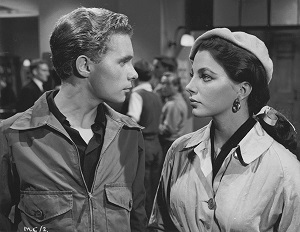 But the reason was the Second World War had deprived a great number of young boys of their fathers, so there was a dire need for male authority figures to step in and shake up these kids and set them on the straight and narrow. There were stories not too far away of Teddy Boys going to see Rock Around the Clock, the now-comically banal vehicle for rock 'n' rollers Bill Haley and His Comets and rioting in the aisles when the music started up, yet while Cosh Boy could have appealed to precisely the kind of delinquent depicted in the title role (James Kenney as Roy Walsh), its tone was less salacious and more stern and grim. But the reason was the Second World War had deprived a great number of young boys of their fathers, so there was a dire need for male authority figures to step in and shake up these kids and set them on the straight and narrow. There were stories not too far away of Teddy Boys going to see Rock Around the Clock, the now-comically banal vehicle for rock 'n' rollers Bill Haley and His Comets and rioting in the aisles when the music started up, yet while Cosh Boy could have appealed to precisely the kind of delinquent depicted in the title role (James Kenney as Roy Walsh), its tone was less salacious and more stern and grim.
Roy more or less betrays everyone around him, and we can see no motive for this: the film certainly doesn't offer one, it's simply that a boy with weak or absent parents is always going to turn to the bad, according to this that is all you need to know. But further than that, this was a wish-fulfilment fantasy, not Roy's, but the authorities, as he may get his way for too long, but he is punished and exposed as a pathetic, whimpering coward the moment anyone stands up to his bullying ways. In the meantime, he has robbed his gran of her life savings (kept in her mattress) and got sixteen-year-old Joan Collins pregnant.
Little wonder the film's glee at kicking the shit out of Roy eventually. He also tries his hand at attempted murder in a bungled robbery (at a wrestling match!) and is generally so irredeemable that there seems little point in trying to reform him: lock 'im up and throw away the key, is the message, and leave society to the decent folks. Needless to say, at this remove some of this prompts unintended laughter, but for the most part there is no humour in the material, its stark, post-Blitz London obviously trying to pick itself up and dust itself down, yet held back by a younger generation who talk back and act worse.
The director of Cosh Boy was Lewis Gilbert, who would enjoy one of the most wide-ranging careers in the British film industry possible at the time, making three James Bond films, Alfie, Educating Rita and The Ten Year Plan. The what? Well, they all have to start somewhere, and one of his earliest efforts was this 1945 public information film which took Charles Hawtrey of Carry On fame around the world of prefabricated housing. Gilbert added a dose of humour to prevent the subject from growing too dry, though later audiences may have found the funniest element Hawtrey having a girlfriend in tow, shown the latest developments in the housing boom.
 You can see that in the extras for the BFI's Flipside release of Cosh Boy, with a whole lot more, including an entire other feature film. Made the same year as the main feature, Gilbert gave his services to the Children's Film Foundation as many in the industry did at that time, directing Johnny On the Run, an earnest tale of a young runaway who is as basically decent as Roy was basically no good. The title character was a Polish refugee in Edinburgh who escapes into the Scottish Highlands, getting mixed up with Sydney Tafler's gangster in the process; evidently intended to foster sympathy for war orphans, it packed plenty of incident into just over an hour. You can see that in the extras for the BFI's Flipside release of Cosh Boy, with a whole lot more, including an entire other feature film. Made the same year as the main feature, Gilbert gave his services to the Children's Film Foundation as many in the industry did at that time, directing Johnny On the Run, an earnest tale of a young runaway who is as basically decent as Roy was basically no good. The title character was a Polish refugee in Edinburgh who escapes into the Scottish Highlands, getting mixed up with Sydney Tafler's gangster in the process; evidently intended to foster sympathy for war orphans, it packed plenty of incident into just over an hour.
In 1954, Gilbert was enthused by the 3D craze, enough to try one of his own, and the half hour short Harmony Lane was the result, delivering a positively music hall variety of acts in the process. Unfortunately for the director (using a pseudonym in case it didn't work out), the short was released "flat", without the process, and he wrote it off as a failure, but it has been seen as intended since, bringing fifties acts like headliner Max Bygraves, guest star Dora Bryan, singing trio The Beverly Sisters and more, including a dose of culture with a ballet sequence and a dancing dog back from the past. Small screen regulars The Television Toppers perform twice, as a comedy policeman looks on.
From 1956, there is an extract of the ITV news show This Week, which delved into the Teddy Boy problem (as many in Britain regarded them at the time) by interviewing a likely lad about his lifestyle. He is something of a mumbler, but does relate that the only time he ever got into a fight was in the Army, that he spends "three guineas" on his hairstyle (we see him undergoing a remarkable hour-and-a-half treatment) and he is very fastidious about his dress sense. He also works nine-hour days, seven days a week, so it's amazing he finds the strength to do very much at all, not to mention his visits to London jazz clubs with his lady friend.
Stranger in the City from 1961 was an early work from Robert Hartford-Davis which in a semi-narrative approach was a precursor of those London documentaries that verged on mondo movie territory. Derek Ford was involved on the production side (as seen in the images of a stripper and artist's model - in a restaurant?!) and as a slice of life as we kind of follow a tramp about the place in comic vignettes, but cut away from him to bits and bobs you could see on the streets, culminating in a trip to the nightlife. There was plenty of charm here, and obviously as a record of the pre-Swinging era, just as it is about to swing, it had a lot of value.
Rounding off the set were an interview with Ian Whittaker, who played Roy's dim-witted sidekick in Cosh Boy, and reminisces for about ten minutes on the play and the making of the film, both of which he appeared in (you'll be glad to know he still had that impressive head of hair), an image gallery consisting of more photos and posters than you might expect, and finally on the disc (Blu-ray and DVD) the American titles, where it was renamed The Slasher and included a moment of pre-credits violence against a little old lady not seen in the British version. In addition, there was an informative booklet crammed with facts about everything featured. All in all, another superior addition to the Flipside brand. And the X certificate? It became the 18 certificate when censors decided X denoted too much excitement and an incentive to watch. That would never do…
 |


