| |
David Essex became a star because of his lead role in That'll Be the Day, having been plucked by producer David Puttnam from the stage show Godspell to embody the restless rock star to be, Jim MacLaine in both it and its inevitable sequel, Stardust. What was curious was the first instalment featured almost no scenes of Essex as a musician, and it was not until the last few minutes that he decided that was what he wanted to do with his life, meaning the experience of watching this in 1973, when it was released, would be different to seeing it after 1974, when Stardust was released, confirming the character's success.
You may have had the impression that Jim was headed for a bigger future, but in contrast to George Lucas's American Graffiti, which That'll Be the Day was often compared to, the nostalgia was tempered by a very British pessimism, a sense that the existence he would be destined for had he not rejected it was all he deserved, and any ideas above his station should be punished. So he leaves school without taking his exams, does not get accepted to university as his mother (Rosemary Leach) wanted, and though a wife and kids and a job as a shopkeeper would appear to be his ultimate fate, it is nothing to do with what he ever wanted himself.
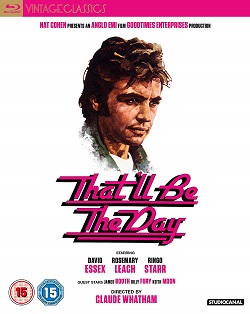 For that reason, MacLaine is dealt a dim hand he must struggle to escape from, and we can tell music will be a major part of that escape, but also he must become callous and surprisingly unlikeable for a protagonist in a rock music film, the sort of character the audience is usually guided to at least have a grudging respect for. As he runs away from home, in a very British choice he heads for the seaside where leisure would seem to rule the day, but can only scrape a living as a deckchair attendant. Still, this does lead him to the fairground and jobs on the dodgems and waltzers, and to a holiday camp where he makes friends with none other than Ringo Starr. For that reason, MacLaine is dealt a dim hand he must struggle to escape from, and we can tell music will be a major part of that escape, but also he must become callous and surprisingly unlikeable for a protagonist in a rock music film, the sort of character the audience is usually guided to at least have a grudging respect for. As he runs away from home, in a very British choice he heads for the seaside where leisure would seem to rule the day, but can only scrape a living as a deckchair attendant. Still, this does lead him to the fairground and jobs on the dodgems and waltzers, and to a holiday camp where he makes friends with none other than Ringo Starr.
Well, technically Ringo was playing Mike, a down at heel lothario who introduces Jim to the world of a new girl every week (after our antihero's initial conquest, Doctor Who's Deborah Watling), which brings up another theme: MacLaine does what he does for sexual satisfaction, maybe even more than pursuing his music career, and if one leads to the other, so much the better. Essex was cast because he had a boyish charm that would excuse his character's bad behaviour, yet that only succeeds up to a point, and in that style he was more akin to the bad boys of television soap opera to come, the man you loved to hate, practically.
If you didn't hate MacLaine, you were intrigued by how far he could get with so few morals to hold him back, getting up to such reprehensible business as raping a teenage schoolgirl when she has the temerity to tell him "no", looking on as Mike is hospitalised by thugs because it will help him get his supposed pal's new job, and the almost-capper, sleeping with his fiancée's best friend on the eve of their wedding, employing a cad's logic to get his way. Rosalind Ayres was the wife left holding the baby, literally, as Jim embarks on the sequel, Stardust, again produced by Puttnam and penned by Ray Connolly, though director Claude Whatham was replaced.
This was thanks to Puttnam believing Whatham was too old to truly understand the rock era, so Michael Apted was brought on instead, having turned down That'll Be the Day and regretted it when it was a substantial hit, partly thanks to its soundtrack of fifties oldies peppering the action and providing a lucrative tie-in compilation album. Puttnam had been inspired by Harry Nillson's song 1941, whose story takes on a loosely similar trajectory, for the opening effort, but now, where that had been steeped in the Britain of twenty years before and tantalising MacLaine with the music that could be his, in Stardust he got everything he wanted.
For greater authenticity, the first movie had cast actual rock stars as well as Ringo, so Billy Fury was a singer at the camp, and Keith Moon (who was instrumental in getting the film completed) was his drummer, and that continued in the follow-up. Starr had declined to return, citing the plot's issues as too close to home, so Adam Faith was his replacement, and once again proved that sometimes a music star can make a very decent actor - Faith had already proven himself for many in that realm from his lead in television drama series Budgie. Keith Moon was back, however, in an expanded role, and fifties pop idol Marty Wilde was present as well.
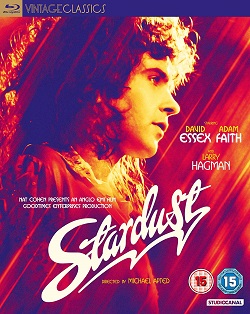 In Jim's new band, Dave Edmunds was a member, largely thanks to him writing and producing most of the music that were not sixties originals, and in Stardust the emphasis was far more on music than it had been before; then it had been almost taunting the protagonist with his unfulfilled dreams of his dearest wishes, but now, he is playing and writing his own material - in a typically bleak joke, when he tries to debut his songs instead of other's hits, they go down like a lead balloon. But the Stray Cats are catching on with their grinding round the calendar gigging, and soon they have a record contract, though not because of their efforts alone. In Jim's new band, Dave Edmunds was a member, largely thanks to him writing and producing most of the music that were not sixties originals, and in Stardust the emphasis was far more on music than it had been before; then it had been almost taunting the protagonist with his unfulfilled dreams of his dearest wishes, but now, he is playing and writing his own material - in a typically bleak joke, when he tries to debut his songs instead of other's hits, they go down like a lead balloon. But the Stray Cats are catching on with their grinding round the calendar gigging, and soon they have a record contract, though not because of their efforts alone.
Mike was back too, and Faith played him as a notably different character, more of a mover and shaker, even a Machiavelli. Now he can work out all sorts of deals to get Jim to the top of the showbusiness tree, which not coincidentally he can leech off, though perhaps that term is not entirely fair and he definitely does feel a companionship with the singer and wants the best for him. Yet as the stardom grows - an unstaged scene at a concert with screaming David Essex fans shows how much the actor/singer was gathering renown himself - Larry Hagman signs up our hero, which signals the start of something big yet also the beginning of the end.
Although Stardust was an even bigger hit than That'll Be the Day, it did not go on to be regarded as a classic British film, possibly because the industry in this country was so much in decline and it was tied in with those doldrums, despite its millions in profits. Also, it was kind of difficult to see away from television broadcasts, though a tyro Shaun Ryder was impressed enough to want to emulate MacLaine when he caught it (listen out for the reference in The Happy Mondays' breakthrough single, Wrote for Luck). If Performance was what all the cool kids wanted to see, maybe that was additionally thanks to Essex's latter career as a light entertainer.
Or something closer to that than what Mick Jagger got up to, but Essex was really not bad at all as Jim, adopting a little boy lost demeanour in Stardust that made him more appealing than previously as the music industry chews him up and spits him out (to paraphrase one advertising campaign for the film). His magnum opus is a groaningly pretentious rock opera broadcast around the world, a tribute to "woman", but already Mike has been whittling away at his friends to ensure he has Jim all to himself: it's genuinely depressing to see him deserted by the end, no matter how awful he acted in That'll Be the Day. With its finale in a Spanish castle retreat, Stardust echoed many a burnt out rock star's tale of woe, some survived, some did not, but thanks to its proximity to high profile showbiz tragedies as the toll of rock 'n' roll became apparent, it's a film of great resonance - and enormous cynicism.
[That'll Be the Day and Stardust are released, fully restored, on Blu-ray by Studio Canal with the following extras:
That'll Be the Day:
New Interview with David Puttnam
New Interview with Bob Stanley
New Interview with Ray Connolly
Stills Gallery
Stardust:
Interview with David Puttnam
Interview with Michael Apted
Interview with Ray Connolly
Stills gallery.] |


